

Rethinking Hospital Decontamination: Why Dry Decon Belongs in Your Emergency Plan
In the event of a chemical incident or mass casualty event, hospitals must act quickly to protect patients, staff, and infrastructure. Traditional water-based technical decontamination has long been a standard protocol, but it brings limitations—especially during high-pressure scenarios where rapid, scalable response is critical.
Today’s global threat landscape—including geopolitical unrest, volatile chemicals, and large-scale gatherings like the upcoming World Cup—requires hospitals, particularly mass casualty centers and Level 1 trauma facilities, to reassess their decontamination protocols and emergency tools.
That’s why hospitals in the USA, Sweden, Canada, and Singapore are turning to dry emergency decontamination solutions like FAST-ACT—a ready-to-use, waterless system designed for speed, safety, and real-world use during chemical, mass casualty incidents.
Limitations of Traditional Decon During Mass Events
In a Preparedness and Response environment, relying solely on water-based cleanup procedures can be risky and impractical. In the case of chemical agent exposure or the use of volatile chemicals, time is critical—and water may not always be the most effective or safest solution.
- Indoor settings and winter conditions may prevent use of showers or rinse stations.
- Rinse runoff increases the risk of secondary contamination and must be treated as hazardous waste.
- Water exposure can damage sensitive equipment and worsen wounds.
- Setup time can delay essential treatment and care to survivors.
- Water-based systems may not scale effectively for mass events.
These scenarios highlight the urgent need for a form of decontamination that is fast, portable, and easy to deploy—without compromising safety.
For more information on Wet vs. Dry decontamination, read more.
What Is Dry Decontamination?
Dry decontamination is a method that uses absorbent materials and active drying agents to neutralize and/or remove chemical threats from skin, hair, surfaces and clothing without the need for water. It’s a proven solution for the safe removal of hazardous agents, especially when water is unavailable or poses additional risks.
What Tools Are Included in FAST-ACT?
The FAST-ACT products designed for contaminant removal and rapid decontamination and neutralization during chemical incidents:
- FAST-ACT 400g Pressurized Cylinder
Enables full-body removal of contamination via dry powder spray. The powder binds and neutralizes toxic chemicals.
- FAST-ACT Decontamination Mitts
These single-use, CE certified mitts are ideal for survivor decontamination on intact skin. They allow staff to pat—not scrub—contaminated areas, providing a quick, targeted solution with minimal irritation or discomfort.
- FAST-ACT Decontamination Wipes
CE Certified, these wipes offer safe removal of contaminants and are ideal for use when more delicate application is needed.
Each component is designed for use by trained health care providers and emergency staff, with minimal setup or infrastructure required.
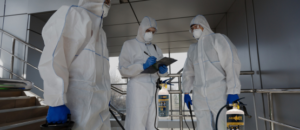
Evidence-Based Performance
FAST-ACT has been independently evaluated and confirmed as effective for contaminant removal and rapid decontamination:
- Reduced chemical contamination levels to below NATO safety thresholds
- Did not interfere with essential treatment or wound healing
- Can be safely used on unconscious or non-responsive patients with basic respiratory protection
- Backed by third-party toxicity testing demonstrating FAST-ACT is non-toxic to eyes, skin, and lungs—proven safe for personnel exposure during use.
This allows hospitals to incorporate FAST-ACT into their decontamination procedural plans with confidence and clinical support.
Scalable, Practical, and Grant-Eligible
With minimal infrastructure required and scalable deployment, FAST-ACT supports hospital needs during mass events, chemical incidents, or planned large gatherings. Many hospitals are now evaluating it as a cost-effective tool for improving Preparedness and Response strategies.
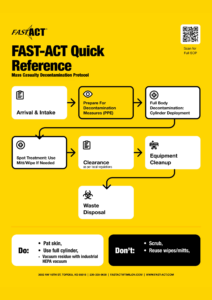
What’s Next
In Part 2 of this series, we will break down the official Hospital SOP for FAST-ACT, offering a detailed look at how trauma hospitals are implementing dry decontamination in real-world emergency scenarios.
For more information on how FAST-ACT can fit into your hospital’s Preparedness and Response plan, reach out to our team.
About Timilon Corporation:
Timilon Corporation is the manufacturer of FAST-ACT®, a proprietary formulation of non-toxic high-performance specialty materials effective at neutralizing a wide range of toxic chemicals with the added capability to destroy chemical warfare agents. The FAST-ACT technology is utilized by leading defense agencies, chemical industrial companies, first responders and HAZMAT teams to quickly and safely eliminate chemical hazards. For more information, reach out to Leticia Menzzano, Marketing Manager, lmenzzano@timilon.com.
FAQs
Why are hospitals using dry decontamination solutions like FAST-ACT?


Hospitals are turning to FAST-ACT because traditional water-based decontamination alone can be slow, impractical, or unsafe during chemical incidents and mass casualty events. Dry decontamination with a hybrid approach allows for rapid, scalable, and safe removal of hazardous chemicals from patients, staff, and equipment.
What is dry decontamination in a hospital setting?
Dry decontamination uses absorbent materials and active agents to neutralize or remove chemical threats from skin, hair, clothing, and surfaces without water. FAST-ACT products provide a proven, waterless solution for fast, safe decontamination.
What FAST-ACT products are used for hospital decontamination?
Key FAST-ACT hospital solutions include: FAST-ACT 400g Pressurized Cylinder: Full-body dry powder spray that binds and neutralizes toxic chemicals. FAST-ACT Decontamination Mitts and FAST-ACT Decontamination Wipes: *CE classified as a class I medical device for use on skin and surfaces in the EU.
How quickly can FAST-ACT be deployed in hospitals?
FAST-ACT solutions require minimal setup, making them ideal for rapid deployment in emergency scenarios, mass casualty events, or high-pressure situations where speed is critical.
Can FAST-ACT be used in large-scale or mass casualty events?
Yes. FAST-ACT products are scalable, portable, and practical, allowing hospitals to respond to multiple patients quickly, even in crowded or resource-limited environments. They are suitable for large gatherings, mass casualty incidents, or chemical exposure events.
Does FAST-ACT support hospital Preparedness and Response plans?
Absolutely. FAST-ACT can be integrated into hospital SOPs, emergency protocols, and mass decontamination plans. Its evidence-based performance and independent safety testing make it a reliable tool for hospital Preparedness and Response strategies.