

Understanding Cyclosarin: A Comprehensive Guide to Its Chemical Properties and Effects
Cyclosarin (GF) is a Chemical Weapon classified under Schedule 1 of the Chemical Weapons Convention. While it is less widely known than Sulfur Mustard or other chemical warfare agents, it is considered one of the most dangerous due to its extreme toxicity and environmental persistence. For First Responders, hazmat teams, and agencies responsible for Chemical, Biological, Radiological, and Nuclear (CBRN) incidents, understanding cyclosarin is essential to Consequence Management and preparedness.
This guide breaks down cyclosarin’s chemical properties, health effects, and environmental behavior, while also showing how FAST-ACT decontamination solutions protect communities against these toxic chemicals.
What Is Cyclosarin?
Cyclosarin, or cyclohexyl methylphosphonofluoridate, is part of the nerve agents family. Closely related to sarin, it is a liquid at room temperature with a sweet or musty odor. Its high boiling point and relatively low volatility make it far more persistent than sarin—evaporating up to 70 times more slowly, according to the National Response Team’s Chemical Update on Cyclosarin.
Unlike faster-dissipating chemical agents such as choking agents like chlorine or riot control agents such as tear gas, cyclosarin lingers in the environment. Porous surfaces such as upholstery, wood, and carpets act as reservoirs, releasing vapors long after the initial release.
Health Risks of Cyclosarin
Cyclosarin’s toxicity comes from its ability to inhibit acetylcholinesterase, leading to overstimulation of the nervous system and ultimately a cholinergic crisis. This is the hallmark of all nerve agents, and it can rapidly progress from mild symptoms to life-threatening conditions.
According to the National Response Team’s QRG:
- Inhalation may cause pinpoint pupils, chest tightness, seizures, or respiratory failure within minutes.
- Skin and surface contact often produces delayed effects such as sweating, twitching, or nausea that can escalate over time.
- High-level exposures can quickly result in paralysis, coma, or death.
Research published in Wiley’s Journal of Applied Toxicology also notes that even low-dose exposures may lead to long-term neurological effects.
Environmental Challenges
Cyclosarin is considered moderately persistent. Outdoors, it contaminates soil, vegetation, and infrastructure; indoors, it can be absorbed by porous materials and persist for days. Its heavy vapors settle in low-lying areas, increasing risk to responders during entry.
Although it slowly hydrolyzes into less toxic byproducts such as methylphosphonic acid, this breakdown is not fast enough for practical safety. Traditional decontamination methods—such as bleach or sodium hydroxide—can work but often pose their own hazards and are difficult to deploy at scale. This is a major issue for hazardous materials teams and makes dry sorbent systems like FAST-ACT more practical in field emergency responses.
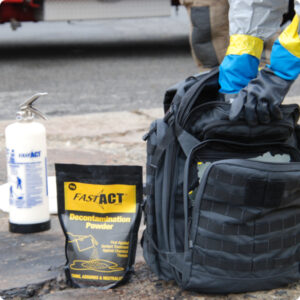
FAST-ACT: Neutralizing Chemical Agents in the Field
FAST-ACT is designed specifically to handle chemical warfare agents, including nerve agents, blister agents, blood agents, riot control agents, and other toxic chemicals. Unlike liquid neutralizers, FAST-ACT uses a mineral-based formulation that is safe for responders, effective on a variety of skin and surface types, and does not generate corrosive byproducts.
Key tools include:
- FAST-ACT Pressurized Cylinder – Quickly suppresses and neutralizes airborne vapors inside enclosed spaces, reducing inhalation risks.
- FAST-ACT Decontamination Mitt – Enables targeted treatment of contaminated gear, surfaces, or small equipment.
- FAST-ACT Bulk Powder Containers – Provide large-scale coverage for spills or outdoor releases.
- FAST-ACT Decontamination Wipes – Offer a convenient way to neutralize hazardous materials during rapid operations, ideal for skin decon and PPE
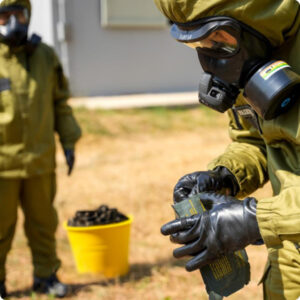
Why FAST-ACT for Nerve Agents
FAST-ACT is a proven solution for nerve agents, combining field-tested performance with responder safety. It has been third-party tested in real-world scenarios, demonstrating rapid and effective neutralization of nerve agents on both skin and surfaces. CE-certified for skin decontamination, FAST-ACT provides a safe, dry decontamination method that avoids the risks of water-based solutions, making it faster, safer, and highly practical for emergency responders.
Detection and Complementary Strategies
Effective response depends on both detection and neutralization. For more on the detection of cyclosarin and related agents, see this LinkedIn article by Proengin, which highlights how advanced monitoring tools confirm the presence of chemical warfare agents in real time.
When combined with FAST-ACT decontamination systems, detection creates a layered defense that enhances readiness for CBRN emergency responses.
Conclusion
Cyclosarin is one of the most dangerous chemical agents, posing unique risks because of its persistence and ability to trigger a cholinergic crisis. For First Responders, hazmat teams, and defense professionals, it represents a worst-case scenario in the landscape of chemical warfare agents.
With solutions like the FAST-ACT Pressurized Cylinder, Decon Mitt, Bulk Powder Containers, and Decontamination Wipes, responders have the ability to neutralize not only cyclosarin but a wide array of toxic chemicals.
Contact FAST-ACT today to learn how our products and training programs can help your agency strengthen its preparedness.
About Timilon Corporation:
Timilon Corporation is the manufacturer of FAST-ACT®, a proprietary formulation of non-toxic high-performance specialty materials effective at neutralizing a wide range of toxic chemicals with the added capability to destroy chemical warfare agents. The FAST-ACT technology is utilized by leading defense agencies, chemical industrial companies, first responders and HAZMAT teams to quickly and safely eliminate chemical hazards. For more information, reach out to Leticia Menzzano, Marketing Manager, lmenzzano@timilon.com.
FAQs
What makes cyclosarin (GF) particularly challenging for responders?


Cyclosarin is highly toxic and significantly more persistent than many chemical agents. Its slow evaporation rate and ability to absorb into porous materials increase long-term vapor hazards, requiring responders to use reliable decontamination tools and strict operational controls.
Why is dry decontamination important for agents like cyclosarin?
Traditional wet decon methods can be difficult to deploy quickly and may introduce secondary hazards. Dry neutralization with FAST-ACT helps responders quickly reduce chemical risks without water, infrastructure, or corrosive byproducts, making it more practical during field operations.
Can FAST-ACT be used on nerve agents such as cyclosarin?
Yes. FAST-ACT is designed to neutralize a wide range of chemical warfare agents, including nerve agents. It is mineral-based, noncorrosive, and safe for use on skin, PPE, and equipment, supporting rapid decontamination during CBRN emergencies.
Does FAST-ACT produce hazardous byproducts when neutralizing chemical agents?
No. FAST-ACT does not generate corrosive or harmful byproducts, which makes cleanup safer and simplifies disposal procedures for responders managing contaminated materials.
How can teams receive training on responding to cyclosarin and other chemical warfare agents?
FAST-ACT provides training programs that help agencies integrate its decontamination tools into existing SOPs and CBRN response plans. Teams can request customized sessions tailored to their operational needs. Contact our team.