

Chemical Emergency Response Equipment for Airports: What’s Needed for Effective Response
Airports are complex, high-traffic environments where even a small chemical incident can escalate quickly. From unknown powders at security checkpoints to hazardous liquids in cargo areas or lithium-ion battery failures, the range of potential risks is broad. These types of incidents can rapidly become both a public safety concern and an operational disruption if not addressed immediately.
Research also supports the scale of this risk. A study published through the National Institutes of Health demonstrates how even short-duration airborne chemical releases in major airport environments can result in widespread exposure across passengers and staff, reinforcing the importance of rapid response and preparedness.
Because of this, having the right chemical emergency response equipment for airports is not just a compliance requirement; it is essential for maintaining safety, continuity, and control during an incident.
This blog will cover the essential equipment needed for effective chemical emergency response at airports, why these tools are critical in aviation environments, and how response strategies can be strengthened to address both liquid and vapor hazards.
Why Airports Require Specialized Chemical Response Equipment
Airports present a unique combination of challenges that make chemical response more complex than in traditional industrial settings. Research highlights how confined spaces, airflow variability, and high occupancy can significantly influence how hazardous substances spread. In airport environments, high passenger density, enclosed spaces, and sensitive infrastructure further increase the risk associated with chemical exposure.
An unattended substance in a terminal, a leaking package in baggage handling, or off gassing from a damaged device can quickly introduce airborne health hazards that impact both passengers and staff.
This risk is further reinforced by broader industry insights. As outlined in this analysis on airport vulnerability to CBRN threats, airports have historically focused on conventional threats like explosives, but chemical and other CBRN risks present a more complex challenge due to their often invisible and difficult-to-detect nature.
Unlike controlled industrial environments, airports must also maintain continuous operations while responding to incidents. This means response equipment must not only be effective, but also rapidly deployable and easy to use in dynamic environments.
What Equipment Is Needed for Chemical Emergency Response at Airports?
Effective response requires a combination of tools that support detection, protection, containment, and decontamination. Each plays a role in managing risk during the earliest and most critical stages of an incident.
Detection and monitoring equipment are critical for identifying hazards early. Airports often rely on chemical detection devices and air monitoring systems to assess threats and guide response decisions. Many organizations align these practices, which emphasize coordinated and informed response strategies.
Personal protective equipment (PPE) is equally essential. Items such as nitrile gloves, safety goggles, respirators, and protective suits ensure that emergency responders, fire departments, and airport personnel can safely manage an incident.
Spill containment equipment plays a key role in controlling hazardous materials and preventing spread across high-traffic areas. In environments like cargo zones, maintenance areas, or refueling operations, rapid containment is critical.
Common spill response equipment includes:
- Spill kits and fluid spill kits
- Materials for managing oil and gasoline spills
Decontamination equipment is another critical component. While water-based systems are widely used, they can be difficult to deploy quickly in airport environments and may not be suitable for sensitive electronics or screening equipment.
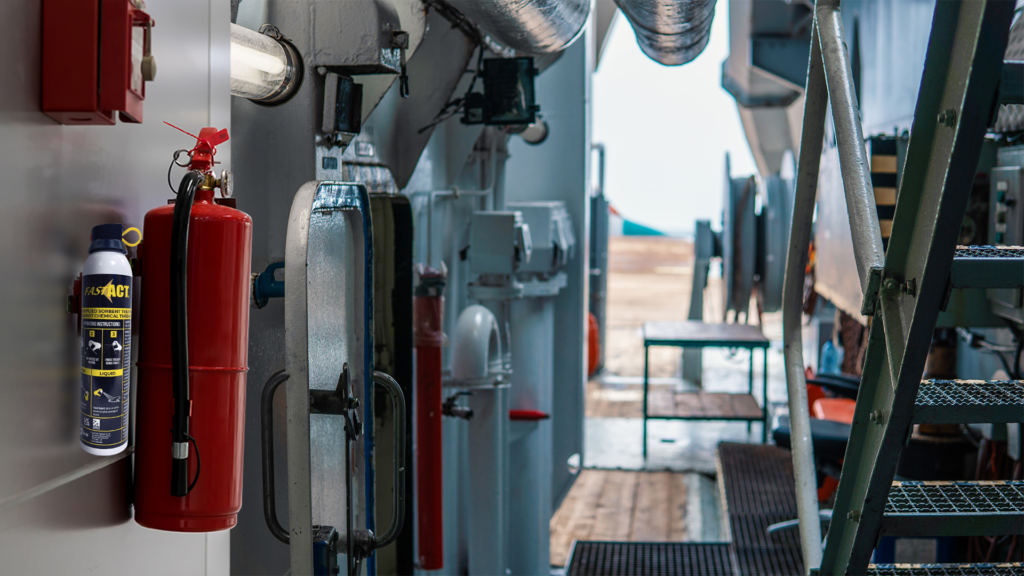
As a result, many response strategies now incorporate dry solutions that can be applied immediately and without additional infrastructure. These approaches allow responders to act quickly at the point of exposure, reducing contamination before it spreads further. Some dry decontamination solutions, such as FAST-ACT®, can be safe to use on skin, surfaces, and sensitive equipment, supporting rapid response in complex airport environments.
Managing Both Liquid and Vapor Hazards in Airports
One of the most important considerations in airport chemical response is the need to address both liquid and vapor hazards. While spills are often visible and easier to identify, vapor releases can spread quickly, especially in enclosed environments such as terminals, jet bridges, and baggage handling areas.
This is particularly relevant in incidents involving lithium-ion batteries, where overheating or damage can release toxic gases alongside hazardous liquid electrolytes. These scenarios require response equipment that can manage multiple forms of contamination at once. Without the ability to address both hazards simultaneously, response efforts may leave gaps that increase exposure risk and prolong disruption.
Operational Challenges in Airport Response
Even with the right equipment in place, airport environments introduce additional challenges that impact how chemical incidents are managed. Response teams must operate in spaces that are often crowded, time-sensitive, and highly visible to the public. At the same time, they must protect critical systems such as security screening equipment, aircraft infrastructure, and communication networks. Effective response in transportation hubs requires balancing safety with operational continuity—minimizing disruption while still addressing the hazard quickly and effectively. This reinforces the need for equipment that is not only effective, but also adaptable to real-world conditions.
Where FAST-ACT® Fits into Airport Chemical Response
To support early-stage response, many airports are incorporating solutions that can be deployed immediately—without waiting for full-scale decontamination systems.
FAST-ACT® provides a dry decontamination approach designed for rapid response in transportation environments. FAST-ACT® enables teams to neutralize chemical threats almost immediately—without water, setup, or delay. This capability supports a range of airport-specific scenarios, including unknown powders at checkpoints, vapor release from lithium-ion battery incidents, and contamination of equipment or surfaces.
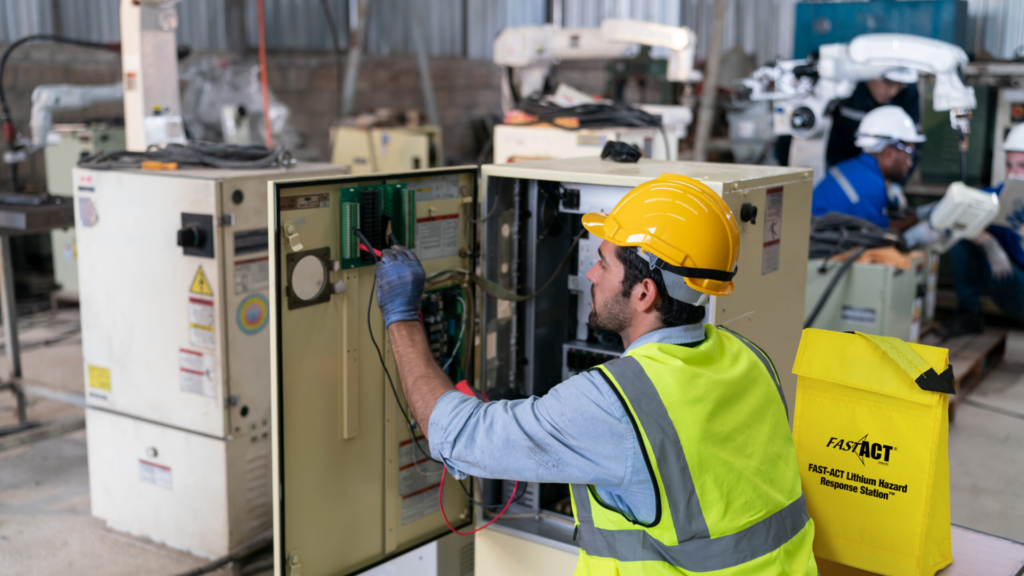
For example, the FAST-ACT® FAST-ACT Lithium Hazard Response Station™ is an all-in-one emergency response solution designed to address chemical hazards associated with lithium-ion battery failures. Whether caused by thermal runaway, physical damage, or device malfunction, these incidents can release both toxic gases and hazardous electrolyte spills. The station enables personnel to safely neutralize airborne chemical vapors and liquid contamination without the use of water or complex procedures—helping minimize exposure risk and operational disruption.
In addition, the FAST-ACT® DEFEND Kit provides a comprehensive solution for incidents involving unknown powders and high-risk substances such as fentanyl. Designed for emergency response and security environments, it supports both detection and decontamination, helping protect personnel, passengers, and critical infrastructure during high-risk exposure scenarios.
FAST-ACT® solutions, including the FAST-ACT® 400g Pressurized Cylinder, FAST-ACT® Decontamination Mitts, and FAST-ACT® Decontamination Wipes, are designed to integrate into existing airport emergency supplies and preparedness programs. Since these tools require no mixing, water, or external infrastructure, they are well-suited for environments where speed, mobility, and equipment protection are critical.
Conclusion
Effective chemical emergency response in airports depends on more than procedures—it requires the right equipment to be available and ready for immediate use. From detection and PPE to containment and decontamination, each component plays a role in reducing exposure, limiting contamination, and maintaining control during an incident. For airport emergency management teams and hazmat responders, the priority is clear: response strategies must be built around speed, accessibility, and real-world conditions. If your team is evaluating chemical emergency response equipment for airports or looking to improve early-stage response capabilities, FAST-ACT® can support your preparedness strategy with solutions designed for transportation environments.
Contact our team to learn more or request test reports.
About Timilon Corporation:
Timilon Corporation is the manufacturer of FAST-ACT®, a proprietary formulation of non-toxic high-performance specialty materials effective at neutralizing a wide range of toxic chemicals with the added capability to destroy chemical warfare agents. The FAST-ACT technology is utilized by leading defense agencies, chemical industrial companies, first responders and HAZMAT teams to quickly and safely eliminate chemical hazards. For more information, reach out to Leticia Menzzano, Marketing Manager, lmenzzano@timilon.com.