

Suspicious Substance Incidents and VIP Security: Why Protective Detail Teams Need a Chemical Response Plan
In the weeks leading up to the 2026 midterm elections, at least 36 members of Congress and election offices in at least 10 states received suspicious envelopes containing unknown substances. HAZMAT teams responded across the country, in New York, Virginia, Alaska, Illinois, Arizona, Florida, and beyond. The FBI and U.S. Postal Inspection Service opened a joint investigation. Rep. Ritchie Torres said what many were thinking: “We are living in a time when threats against elected officials and their staff have become the new normal.”
What is unfolding right now is not an anomaly. Nebraska’s Secretary of State confirmed this was the second suspicious envelope delivered to his office, the first arrived during the 2024 election cycle. The U.S. Postal Inspection Service noted that suspicious packages arriving at political offices during election season is “not necessarily uncommon.”
That pattern is the starting point for this blog. Because while the 2026 wave is making headlines today, the underlying risk to VIP security teams, protective details, office security managers, and the personnel responsible for keeping elected officials safe, exists year-round. And most protective detail teams do not have a chemical response plan that accounts for it.
Is a Suspicious Substance Incident a VIP Security Problem?
Most VIP security planning focuses on physical threats, access control, route security, crowd management, and close protection. A unknown substance in an envelope does not fit neatly into any of those categories, which is exactly why it tends to fall through the gaps. But a suspicious substance incident at a political office is a VIP security problem from the moment the envelope is opened.
While most substances in the current wave have been determined non-hazardous after testing, every single incident required a full HAZMAT response, evacuations, medical screenings for exposed staff, and significant operational disruption. The principal’s schedule stops. Staff are quarantined. The office becomes a scene. Whether the unknown substance is harmful or not, the security failure is the same: the team was not prepared for it.
For VIP security professionals, the question is not whether a suspicious substance incident will require a response. It is whether the response will be controlled or improvised.
What Makes Suspicious Substance Incidents Difficult for Protective Detail Teams?
A suspicious substance incident in an office environment is operationally different from almost every other threat a protective detail trains for.
The hazard is invisible. There is no visible threat to react to, no clear perimeter to establish, and no obvious action to take beyond the initial “stop contact” instinct” instinct. The substance may already be on hands, clothing, and surfaces before anyone realizes what has happened. And unlike a physical security threat, the contamination does not stop when the principal is moved; it travels with anyone who was in the room.
According to OSHA’s HAZWOPER standard, responding to hazardous materials releases requires established emergency response plans, trained personnel, appropriate PPE, and defined decontamination procedures. Most protective detail teams are not trained or equipped for technical HAZMAT response, and they should not be. That is what specialized HAZMAT teams are for. But there is a critical window between the moment an envelope is opened and the moment a HAZMAT team arrives. What happens in that window matters.
Having a defined strategy for unknown substance response before an incident occurs is what determines whether those first minutes are controlled or chaotic. The goal for a protective detail is not to run the HAZMAT response. It is to protect the principal, isolate exposed personnel, and hand a manageable scene to the responders arriving behind them.
What Should the First Five Minutes Look Like for VIP Security During a Suspicious Substance Incident?
The first five minutes are protective detail work, not investigative work.
Move the principal away from the affected area immediately. Isolate exposed staff separately from unexposed staff, movement spreads contamination and extends the contamination footprint before HAZMAT personnel arrive. The person who opened the envelope is the primary contamination concern, not the envelope itself. That individual should not move through the building.
Shut down HVAC for the affected zone if accessible without crossing the contaminated area. Close the door. Account for everyone who entered the space since the package arrived. Notify the FBI, local fire HAZMAT, and building security simultaneously. Notification should happen in parallel with response actions, not after scene stabilization.
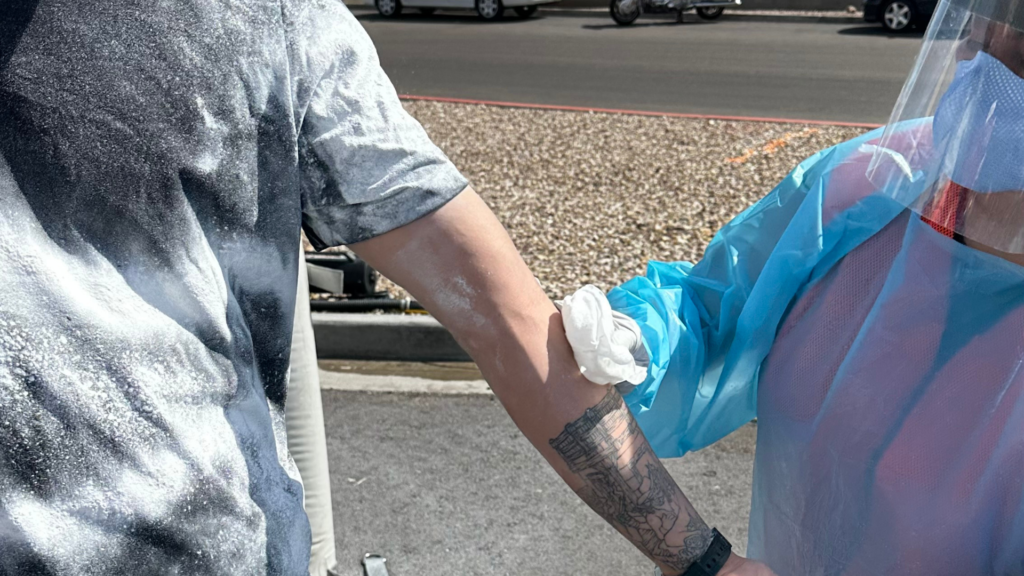
Decontamination in high-risk environments introduces operational realities that shift rapidly, and the decisions made in the first five minutes directly affect what HAZMAT teams inherit when they arrive. Common coordination pitfalls between first responders and receiving facilities, including failure to communicate what decontamination has or has not occurred, are among the most preventable failures in the response chain.
Why Is Dry Decontamination a Better Fit Than Wet Decontamination in an Office Environment?
When most people think of decontamination, they picture water, showers, hoses, and rinse stations. That infrastructure might make sense at an outdoor HAZMAT scene. It creates significant problems in a carpeted congressional office or government building.
Water-based decontamination in an enclosed office generates runoff that can carry contamination under doors, into HVAC returns, and across electrical equipment, potentially converting a localized incident into a building-wide concern. It can also damage servers, voting equipment, and records. According to NCBI research on decontamination strategies, water-based methods dilute and remove contaminants but do not necessarily neutralize them, and contaminated runoff may require additional collection and treatment.
FAST-ACT Dry decontamination does not generate runoff. It does not require water supply, drainage, or infrastructure. It can be deployed immediately in the environment where the incident occurred, on surfaces, equipment, and skin, without creating secondary contamination concerns. Whether dry or wet decontamination is right for the situation depends on the environment and available resources. In an occupied office building, dry decontamination is consistently the more practical early-response option.
How Does FAST-ACT Support Suspicious Substance Response for VIP Security Teams?
FAST-ACT dry decontamination is a chemical response tool — the same type of rapid decontamination capability that HAZMAT teams rely on for early-phase chemical response. The difference for VIP security environments is that this capability needs to be immediately accessible at the point of contact, not waiting in a HAZMAT vehicle down the street.
HAZMAT teams use dry decontamination for rapid chemical response because it can be deployed immediately, requires no water or setup, and supports contamination management during the critical early window before comprehensive operations are established. VIP security teams operating in political offices and government buildings need the same capability available for the same reason — the gap between exposure and HAZMAT arrival is measured in minutes, and that window matters.
The science behind FAST-ACT’s dry decontamination technology uses a neutralization-based formulation, rather than simply absorbing a contaminant. It works to neutralize hazardous chemicals on contact. FAST-ACT requires no water and can be used as a standalone dry decontamination method.
FAST-ACT Decontamination Mitts and Decontamination Wipes provide portable options for targeted decontamination of skin, surfaces, and equipment, CE certified as Class I medical devices in the European Union. The FAST-ACT 400G Pressurized Cylinder provides a portable format for broader-area applications and vapor response scenarios, with an average discharge time of approximately 9.9 seconds.
For VIP security teams, having the same dry decontamination tools that HAZMAT teams deploy for rapid chemical response, staged at the point of contact, not in a vehicle outside or a supply room down the hall, ensures the capability is there when the window is open.
What Should VIP Security Teams Do to Prepare Before an Incident Occurs?
The most important preparedness step for any protective detail team is establishing a response plan before a suspicious substance incident occurs, not during one.
That plan should address several practical questions: Who in detail is responsible for isolating exposed personnel? What is the notification protocol and who gets called first? Where is decontamination capability staged relative to where the principal spends time? How will the detail coordinate with local fire HAZMAT when they arrive?
Annual emergency management training that incorporates suspicious substance scenarios, not just physical security drills, ensures that protective detail teams can execute a controlled response under real-world pressure. First responder health and safety depends on having the right tools, the right training, and the right protocols in place before the incident occurs.
The 2026 election wave is a reminder that this threat is real, recurring, and bipartisan. It targets offices of both parties, in every state, during every major election cycle. A protective detail that has never thought through a suspicious substance response is not fully prepared, regardless of how strong every other element of their security plan is. The best time to build that plan is before the next threat arrives.

About Timilon Corporation:
Timilon Corporation is the manufacturer of FAST-ACT®, a proprietary formulation of non-toxic high-performance specialty materials effective at neutralizing a wide range of toxic chemicals with the added capability to destroy chemical warfare agents. The FAST-ACT technology is utilized by leading defense agencies, chemical industrial companies, first responders and HAZMAT teams to quickly and safely eliminate chemical hazards. For more information, reach out to Leticia Menzzano, Marketing Manager, [email protected].
FAQs
Why is a suspicious substance incident a VIP security problem?


Because every incident, regardless of whether the substance is hazardous, triggers a full HAZMAT response, evacuations, medical screenings, and significant operational disruption. The principal’s schedule stops and the office becomes a scene. A protective detail that has no plan for this scenario is not fully prepared, no matter how strong every other element of their security plan is.
Why is dry decontamination better suited to an office environment than wet decontamination?
Water-based decontamination generates runoff that can spread contamination through HVAC systems and across electrical equipment, potentially converting a localized incident into a building-wide problem. FAST-ACT Dry decontamination requires no water, drainage, or setup. It can be deployed immediately on surfaces, equipment, and skin without creating secondary contamination concerns, making it the more practical option in an occupied office building.
How does FAST-ACT support suspicious substance response for VIP security teams?
FAST-ACT is the same type of dry decontamination technology that HAZMAT teams use for rapid chemical response, VIP security teams simply need that capability accessible at the point of contact rather than waiting in a HAZMAT vehicle. FAST-ACT requires no water and can be used as a standalone dry decontamination method. Products include Decontamination Mitts and Wipes for targeted skin and surface decontamination, and the 400G Pressurized Cylinder for broader-area and vapor response applications.