

What Makes the 2028 Olympics a Unique Chemical Preparedness Challenge?
A chemical release inside a packed Olympic arena does not behave like a tanker rollover on an empty highway. It behaves like a crowd problem with a toxicology clock attached. The 2028 Games center on Los Angeles, where a sprawling, largely open-air venue footprint is threaded through a metropolitan basin where refining, rail, port and chemical storage operations sit within short transport distance of planned event zones. But the Games will not stay within one city. Competition sites span roughly 1,500 miles across the U.S., with softball and canoe slalom held in Oklahoma City, so host communities in multiple states share responsibility for keeping crowds safe.
According to the Southern California Association of Governments, the Games are expected to draw roughly 10 to 15 million spectators, with 49 venues confirmed. The U.S. Secret Service has also designated the 2028 Games a national special security event. Aerosolized agents in open stadium concourses and transit chokepoints disperse unpredictably, and ticketed perimeters do little to contain vapor.
Scale compounds the problem. At the Paris 2024 opening ceremony, 45,000 police were backed by 18,000 military personnel across Paris and the surrounding region. Add a multilingual international crowd with no shared evacuation vocabulary, and the triage assumptions built into standard HAZMAT doctrine begin to strain. Chemical preparedness for mass gatherings must account for tens of thousands of people who cannot be line-ordered through a corridor on command.
The bottleneck is not detection. It is the gap between alarm and water.The minutes a “rinse and wait” model cannot buy back. It is the same challenge that made dry decontamination for mass gathering events a priority for response teams ahead of the 2026 FIFA World Cup.

How Can Federal and Local Agencies Coordinate HAZMAT Response at LA28?
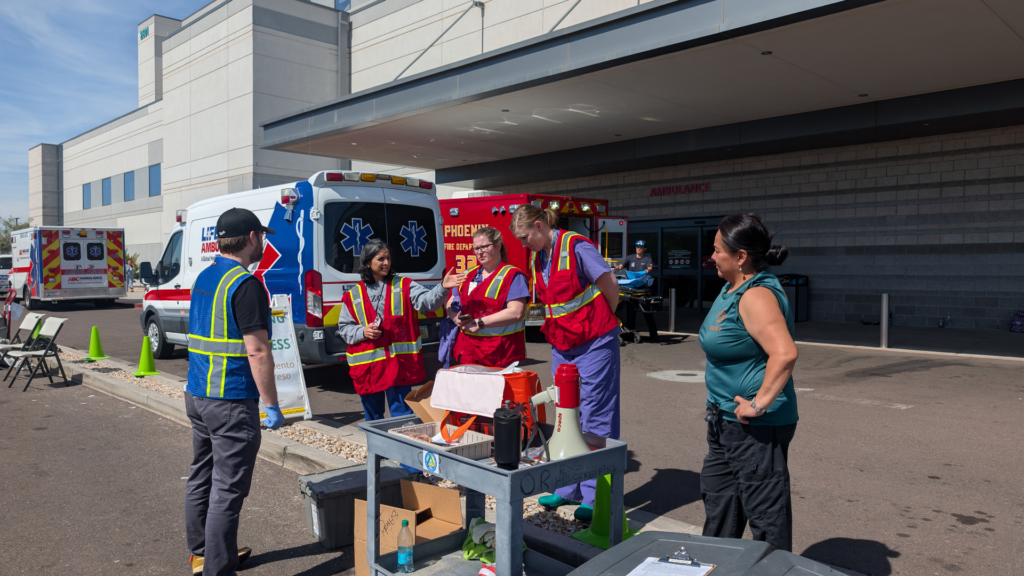
HAZMAT response for the 2028 Olympics will not be run by a single authority, or even a single state. Venue security contractors, municipal fire departments, county HAZMAT units, EMS transport providers, federal assets, and receiving hospital decon teams in every host community each own a slice of the timeline. Specialized military units typically reinforce local capability rather than replace it, supplying high-tier detection, sampling and mobile laboratory support that shortens the interval between “something is wrong” and “here is the agent class.”
Coordination between agencies tends to break down in predictable places. Three recur:
- Radio and data fragmentation between private venue security and public safety dispatch.
- Unclear handoff authority at the warm-zone boundary, where EMS inherits patients whose contamination status was never formally recorded.
- Hospital notification lag, leaving emergency departments to discover agent types from arriving patients rather than from the field, one of the most common decontamination gaps between hospitals and first responders.
Standardized decontamination tools across every tier and every host city remove one variable from those handoffs: whatever agency touches the patient first is doing the same thing to the same standard.
Why Does Immediate Dry Decontamination Matter in Mass Casualty Events?
Wet decontamination corridors require water supply, containment, privacy screening, runoff management and personnel in Level B or C. Standing that up takes time measured in tens of minutes, which is one of the key limitations of water-based decontamination during mass events. Contaminant absorption does not pause for logistics. Liquid agents on skin and clothing continue to penetrate and continue to off-gas, exposing bystanders, responders and the interior of every ambulance that moves a patient.
The research supports acting early. In a study published through the National Library of Medicine, every dry decontamination procedure tested significantly reduced the skin penetration rate of the industrial chemical 2-butoxyethanol compared with no decontamination. Federal guidance reaches the same conclusion. The HHS-sponsored PRISM guidance found that immediate dry decontamination can be highly effective on its own when performed under first responder direction, removing up to 99 percent of contamination. As BARDA’s director noted, these steps can begin without waiting for equipment set up. Researchers have also found that dry decontamination was consistently more effective than a standard rinse-wipe-rinse method for removing liquid contaminants, and that showering contaminated skin may increase absorption of some chemicals through a “wash-in effect”.
Dry decontamination addresses the problem at its source. Bulk liquid is physically removed and bound rather than mobilized, so no contaminated runoff turns a localized incident into a drainage and soil problem. For sensitive electronics, for weapons and comms equipment, and for high-traffic venue entrances where a water corridor cannot physically be built, dry decontamination is often the most practical method available. FAST-ACT’s own hospital demonstration includes time-to-decontamination comparisons between dry and wet systems.
How Does FAST-ACT Fit Into the First-Responder Toolkit?
FAST-ACT is a proprietary, non-toxic formulation of high-performance specialty materials that decontaminates, contains, and neutralizes a broad range of chemical hazards rather than targeting a single agent family.
It acts on both liquid contamination and chemical vapors, which matters when the exposure pathway is inhalation as well as contact. Because it works dry, it can be deployed inside structures and around equipment that water would damage. It can be used on its own or alongside existing wet decontamination procedures.
Venue Security
FAST-ACT Pressurized Cylinders let non-HAZMAT security personnel knock down a chemical vapor and contain a vapor release at a gate or concourse before specialist units arrive. They come in 400g, 1kg, 2kg, and 4kg sizes, so teams can match the cylinder to the exposure level and area of concern. The application requires minimal training. The objective is containment and crowd protection, not technical mitigation.
EMS and Fire
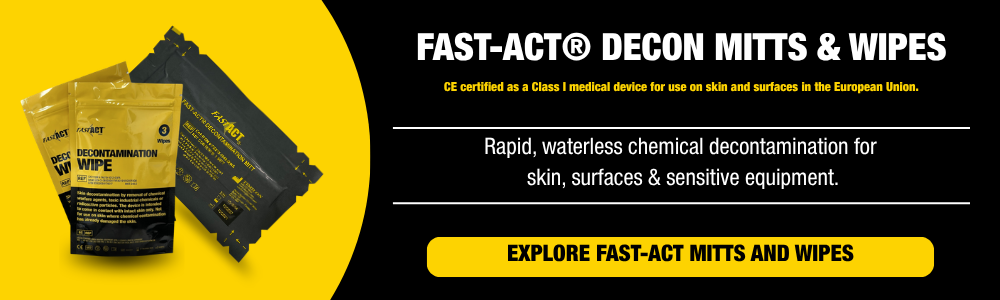
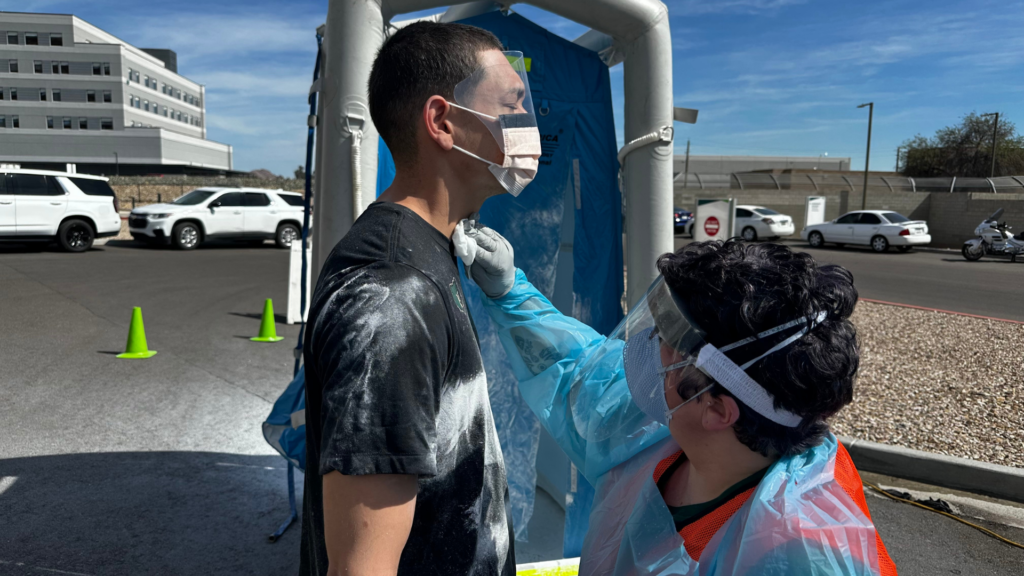
FAST-ACT Decontamination Wipes and Decontamination Mitts support immediate skin decontamination during the window before a wet corridor exists, the critical period covered in our guide to dry decontamination in the first 15 minutes. Crews can treat exposed casualties in place rather than moving contamination down the line.
Hospital Emergency Staff
Patients who received dry decontamination in the field arrive carrying less agent and off-gassing less vapor. That protects triage staff and reduces the risk of an emergency department closure from secondary contamination. Facilities can build these steps into their workflow with a hospital dry decontamination SOP. Dry decontamination functions as a bridge to definitive medical treatment, not a substitute for it.
What Can the 2028 Games Learn From Proactive Mitigation at Previous Olympics?
The record of recent Games shows that heavy investment in chemical preparedness pays off in an absence of headlines. Thousands of personnel, layered detection and standing decontamination capability produced no mass chemical casualty event in Paris. France’s national public health agency, Santé publique France, later published a full review of its Paris 2024 health surveillance work, noting that the effort left a lasting legacy of new surveillance systems and partnerships for future mass gatherings.
That is the point. An enormous security footprint, operating against a credible threat environment, can keep a mass gathering safe. Preparedness of this kind is invisible by design. Rapid decon readiness functions simultaneously as deterrent, a visible signal that a release would be contained rather than catastrophic, and as the safety net that makes the deterrent credible.
What Should Agencies Prioritize for LA 2028 Preparedness?
Agencies in every host community building procurement and training plans this year should anchor them to the following priorities:
- Treat dry decontamination as an immediate first action, not a preliminary step. Removing and binding agents at the point of contact reduces systemic toxicity risk before a patient reaches a hospital corridor.
- Equip every tier of response, not just HAZMAT. Venue security, EMS and fire crews all encounter casualties before specialized units arrive; broad-spectrum tools in all three hands make handoffs predictable.
- Design mass casualty decontamination planning around crowd density, not ideal conditions. In a packed concourse, the capacity to decontaminate where people are standing matters more than the throughput of a corridor they cannot reach.
- Select dry technologies such as FAST-ACT that cover both liquid and vapor hazards. Liquid spills and chemical vapors are addressed with one product, without water supply, runoff containment or the setup time a wet system demands.
Rapid chemical decontamination delivered in the first minutes is what keeps a toxic industrial chemical response from becoming a mass casualty event.
What Does the Future of Mass Gathering Security Look Like?
The 2028 Games will ask more of responders than previous host cities have. The venue footprint is wider and spread across multiple states, the perimeters are more porous, and in Los Angeles the industrial geography sits closer to the crowd. Agility, not volume, is the variable that scales with that reality. A response model that depends on water, containment berms and setup time will always arrive after the exposure has already done its work.
The practical question for every agency now is narrow and answerable: can a casualty be decontaminated where they fall, by whoever reaches them first, within minutes?
FAST-ACT exists for that window: dry, effective against liquid and vapor chemical hazards, and deployable by personnel who are not HAZMAT technicians. Explore FAST-ACT training resources and product configurations to match capability to your venue profile.
The Games will be judged safe in hindsight. That verdict is earned in advance, by responders who equipped for the worst day and then never needed it.
Preparing Hospitals for the 2028 Games: Join Our Upcoming Webinar
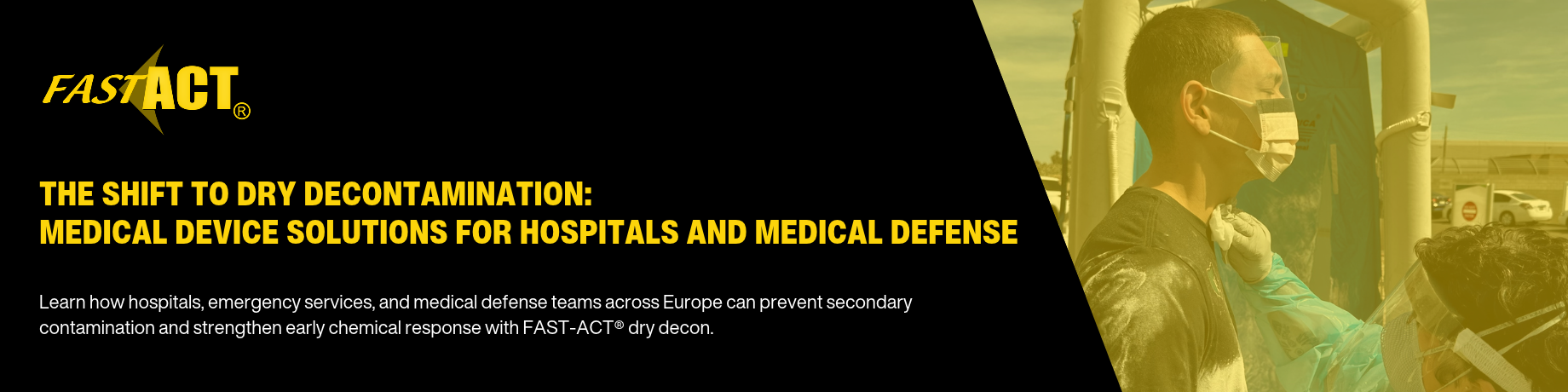
When a chemical release happens at a crowded venue, many exposed people won’t wait for a decon line. They’ll head straight to the nearest hospital. For host communities preparing for the 2028 Games, that makes hospital readiness just as critical as on-scene response.
Join Kyle Knappenberger, VP of Technology at Timilon, on Tuesday, December 8 at 10:00 AM EST for The Shift to Dry Decontamination: Medical Device Solutions for Hospitals and Medical Defense. Learn how on-contact neutralization helps hospitals and medical defense teams prevent secondary contamination and stay operational during mass casualty chemical incidents.
About Timilon Corporation:
Timilon Corporation is the manufacturer of FAST-ACT®, a proprietary formulation of non-toxic high-performance specialty materials effective at neutralizing a wide range of toxic chemicals with the added capability to destroy chemical warfare agents. The FAST-ACT technology is utilized by leading defense agencies, chemical industrial companies, first responders and HAZMAT teams to quickly and safely eliminate chemical hazards. For more information, reach out to Leticia Menzzano, Marketing Manager, [email protected].
FAQs
Why is dry decontamination important for the 2028 Olympics?


Large, open-air venues and dense crowds make it difficult to set up wet decontamination corridors quickly. Dry decontamination lets responders begin removing chemical contamination immediately, without water, setup time, or contaminated runoff, during the critical first minutes of an incident.
Who should carry dry decontamination tools during mass gathering events?
Every tier of response that may reach a casualty first, including venue security, EMS, fire crews, and hospital emergency staff. Equipping all of them with the same tools makes handoffs between agencies more predictable.
How does field dry decontamination help hospitals?
Patients who receive dry decontamination in the field arrive carrying less chemical agent and off-gassing less vapor. This protects triage staff and lowers the risk of an emergency department shutting down due to secondary contamination.
What FAST-ACT products support mass gathering chemical preparedness?
The full FAST-ACT product line supports mass gathering chemical preparedness. Every product uses the same dry formula that decontaminates, contains, and neutralizes a broad range of chemical hazards. Teams can choose the format that best fits their role. Pressurized Cylinders work well for vapor and spill control at venues, Decontamination Wipes and Mitts handle immediate skin decontamination.