
Join Our FREE Webinar: The Shift to Dry Decontamination: Medical Device Solutions for Hospitals and Medical Defense
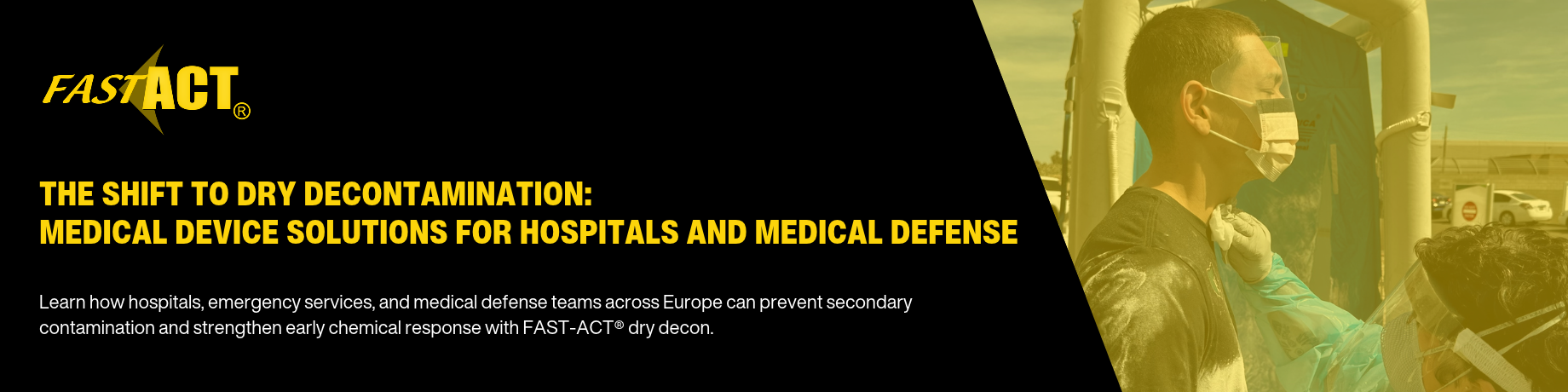
When a chemical exposure occurs, contaminated patients and casualties often arrive at hospital emergency departments and military medical treatment facilities before full decontamination is in place. In that early window, hazardous chemicals on skin and clothing can spread to medical staff, equipment, and treatment areas.
Join FAST-ACT for a FREE live webinar on the shift to dry decontamination in healthcare and medical defense. The session will explore how a medical device designed for patient decontamination, neutralizing chemical agents on contact, helps prevent secondary contamination. It will also cover how hospitals and military medical teams can build practical protocols for both accidental chemical exposures and deliberate incidents.
The discussion draws on FAST-ACT’s work with healthcare and defense partners across Europe and Asia, offering an international perspective on hospital chemical decontamination and decontamination for defense and military medical teams.
What You’ll Learn
During this live webinar, attendees will gain practical insights into:
- The shift to dry decontamination: why early dry decontamination is changing how civilian and military medical teams manage chemical exposures
- FAST-ACT® as a medical device: what it means to use a dedicated medical device for patient decontamination, and where it fits in clinical and field medical settings
- Clinical benefits of on-contact neutralization: how neutralizing chemical agents on contact helps protect medical staff, patients, casualties, and equipment from secondary contamination
- Protecting treatment areas: managing self-presenting patients and incoming casualties before full decontamination is available, from the emergency department to the field hospital
- Building protocols around fast-deployment tools: practical steps for hospital preparedness leads, emergency managers, and medical defense planners preparing for accidental exposures and deliberate incidents
- Integrating FAST-ACT® into preparedness plans: how FAST-ACT® Dry Decontamination deploys without water or fixed infrastructure, standalone or alongside wet decontamination, in emergency departments, ambulance bays, field hospitals, forward medical teams, and medical treatment facilities
The session will close with a live Q&A, giving attendees the opportunity to ask questions directly.
This webinar is completely FREE, but registration is required and spaces are limited.
Don’t miss this opportunity to learn how dry decontamination is helping hospitals and military medical teams protect staff, patients, and treatment areas in the critical window before full decontamination is in place.
Date: Tuesday, December 8, 2026
Time: 10:00 AM EST (15:00 GMT / 16:00 CET)
Format: FREE Live Webinar on Microsoft Teams
Includes: Live audience Q&A with Kyle Knappenberger
About Timilon Corporation:
Timilon Corporation is the manufacturer of FAST-ACT®, a proprietary formulation of non-toxic high-performance specialty materials effective at neutralizing a wide range of toxic chemicals with the added capability to destroy chemical warfare agents. The FAST-ACT technology is utilized by leading defense agencies, chemical industrial companies, first responders and HAZMAT teams to quickly and safely eliminate chemical hazards. For more information, reach out to Leticia Menzzano, Marketing Manager, [email protected].
FAQs
What is dry decontamination?


Dry decontamination removes hazardous chemicals from a person's skin, hair, and clothing without water. FAST-ACT® Dry Decontamination decontaminates, contains, and neutralizes chemical agents on contact, so it can be used immediately, before wet decontamination or fixed infrastructure is available.
Why is early decontamination important for hospitals and military medical teams?
Contaminated patients and casualties often arrive before full decontamination is set up. Without early decontamination, chemicals on their skin and clothing can spread to medical staff, equipment, and treatment areas, putting care teams and other patients at risk.
What is secondary contamination?
Secondary contamination happens when a hazardous chemical transfers from a contaminated person to someone or something else, such as a nurse, a stretcher, or an emergency department bay. Neutralizing chemicals on contact helps stop that transfer at the source.