

Before Full Decontamination Is Ready: What Should First Responders Do in the First Minutes?
In our first two articles, we looked at what happens when a potentially contaminated patient reaches the hospital and how EMS can strengthen the handoff between the scene and the receiving facility. But that response begins even earlier.
It starts when Fire and HAZMAT teams arrive on scene and begin assessing the hazard, protecting responders, managing exposed individuals, and coordinating additional resources.
In a chemical incident, the first few minutes can be challenging. The substance may not yet be identified; the number of exposed individuals may still be unclear, and a full technical decontamination operation may still be getting established.
That creates an important early-response window. What can first responders do during that window to protect themselves, manage contamination, and support the transition to full decontamination?
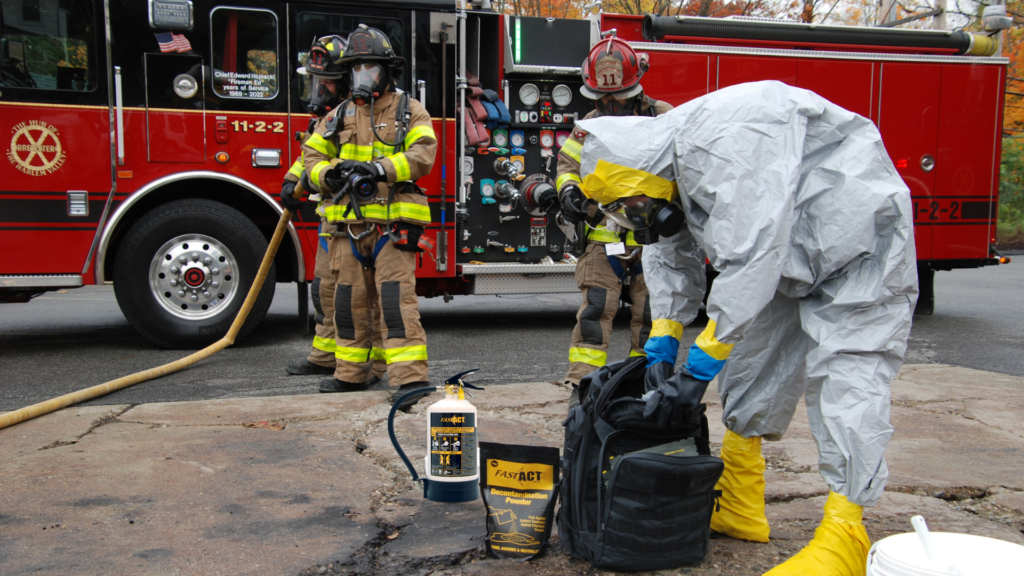
What Should First Responders Do When They Arrive at a Chemical Incident?
The first priority is understanding the scene before moving into an area where contamination may be present.
Recognizing the incident and conducting a rapid scene assessment are fundamental parts of the initial response, and the decisions made in the first few minutes will often establish the character of the overall response. First responders need to consider the type and scale of the incident, potential hazards, and the resources required to manage it.
Information may come from facility personnel, container markings, placards, shipping documents, alarms, witnesses, or visible signs of a release. Physical scene indicators for early hazard identification, including NFPA 704 placards, container types, and facility signage, can give responders critical information within seconds of arrival. The chemical may not always be immediately identified, but having a defined strategy for unidentified hazardous materials before an incident occurs is one of the most important steps any Fire or HAZMAT team can take.
That does not mean responders have to wait for complete identification before taking appropriate protective measures.
The initial assessment helps determine how the scene should be approached, what PPE and resources may be required, and whether additional HAZMAT, EMS, fire, law enforcement, or emergency management resources should be requested. Early resource requests during the first 10 minutes of a HAZMAT call are essential because it takes time for all of these resources to mobilize, arrive, set up, and operate effectively. Early recognition and notification are paramount to preserving that time.
The important point is that scene management and decontamination planning begin before the full decontamination operation is ready.
How Long Does It Take to Establish Full HAZMAT Decontamination?
Full technical decontamination requires personnel, equipment, PPE, water, or other resources, and an organized operating area. Those resources take time to arrive and establish.
CBRN setup and decontamination capability gaps across the United States mean that following best practices, the full setup and entry process can take about an hour, and decontamination deployment strategies have not kept pace with advances in detection and entry team capabilities.
Personnel requirements for establishing two decon lines simultaneously, one for responders and one for victims, can easily require 20 to 30 people for a single entry and resulting decon operation. Technical decontamination should be fully operational before the entry team begins operations in the hot zone, but how remote HAZMAT response delays technical decon setup is a reality many jurisdictions face, and while the response and setup of technical decon is taking place, chemicals are continuing to harm victims.
While that process is underway, exposed individuals may still require attention.
A response should not be built around the assumption that full decontamination capability will be immediately available when the first patient needs assistance. Instead, Fire and HAZMAT teams should understand what actions can be taken safely during the early stages and how those actions transition into the full decontamination operation.
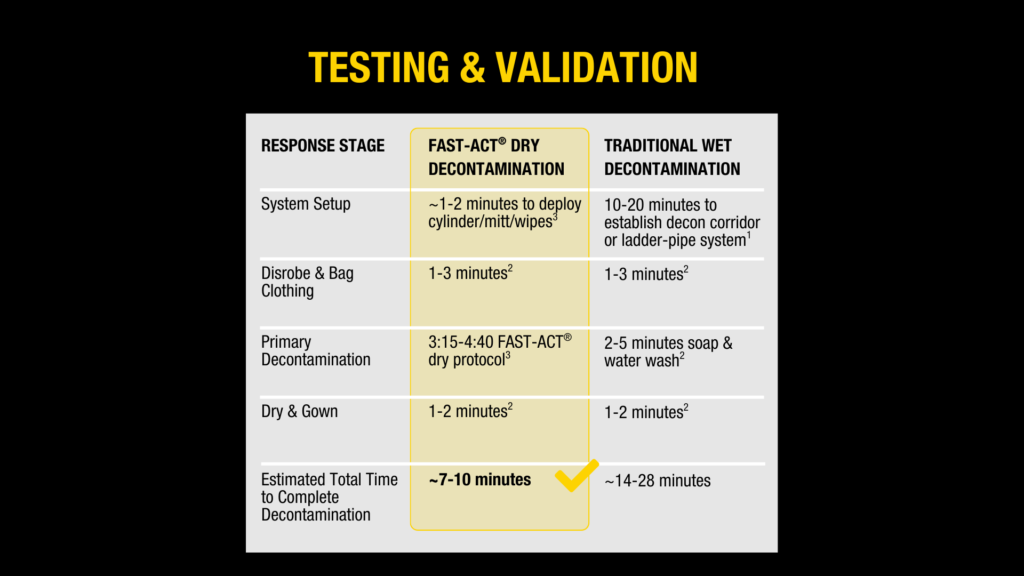
This may include controlling access to contaminated areas, removing contaminated clothing when appropriate, protecting exposed individuals from further contact, coordinating with EMS, and determining whether an early decontamination method is appropriate for the situation. The goal is not to replace technical decontamination. It is to begin addressing contamination while the larger response is being established.
What Can First Responders Do Before Full Decontamination Is Established?
Early actions should be based on the hazard, the patient’s condition, responder safety, and the resources available.
One of the most important considerations is preventing contamination from spreading beyond the initial area. Limiting contamination spread, according to FEMA, is the single most effective means of reducing the level and complexity of response and recovery activities, including remediation time and cost. Early actions by Fire and HAZMAT teams that control contamination spread directly reduce what EMS, hospitals, and environmental agencies face downstream.
When appropriate, removing contaminated clothing can significantly reduce external contamination. Disrobing as a high-impact early decontamination step, identified by the PRISM framework developed through BARDA, can eliminate approximately 80–90% of external contamination and represents one of the most time-critical and operationally impactful steps in the early response.
Early decontamination can then become another part of the response when circumstances and available resources support it. Whether dry or wet decontamination is right for the situation is one of the most important early decisions Fire and HAZMAT teams face, and one that should be addressed in training and protocols before an active incident.
How Can Dry Decontamination Support Early HAZMAT Response?
Dry decontamination can provide an early-response option when appropriate, particularly when water-based decontamination is not immediately practical.
Dry decontamination effectiveness before specialist resources arrive has been demonstrated in controlled research that combinations of dry and wet approaches provided additional benefit during the early stages of an incident. Dry decontamination effectiveness in a 300-person field exercise at the University of Rhode Island further confirmed that the introduction of an immediate disrobe and dry decontamination stage for casualties waiting for wet decontamination offered a rapid and effective initial response with minimal operational impact.
The operational advantage is straightforward, portable dry decontamination without water, shower systems, or runoff collection is easier to deploy while responders are establishing the larger response. The science behind FAST-ACT’s dry decontamination technology explains why its neutralization-based formulation is particularly effective during this early window, when the goal is rapid contamination reduction before comprehensive decontamination systems are in place.
FAST-ACT provides dry decontamination solutions designed for first responders and HAZMAT teams. For targeted decontamination, FAST-ACT Decontamination Mitts and Decontamination Wipes are designed for use on skin, surfaces, and sensitive equipment. The Mitts and Wipes are CE certified as Class I medical devices for use on skin and surfaces in the European Union.
For larger areas and applications involving whole-body decontamination or chemical vapor threats, the FAST-ACT 400G Pressurized Cylinder provides a portable format for rapidly deploying FAST-ACT during an appropriate response, with an average discharge time of approximately 9.9 seconds, making it well suited for fast-moving HAZMAT environments.
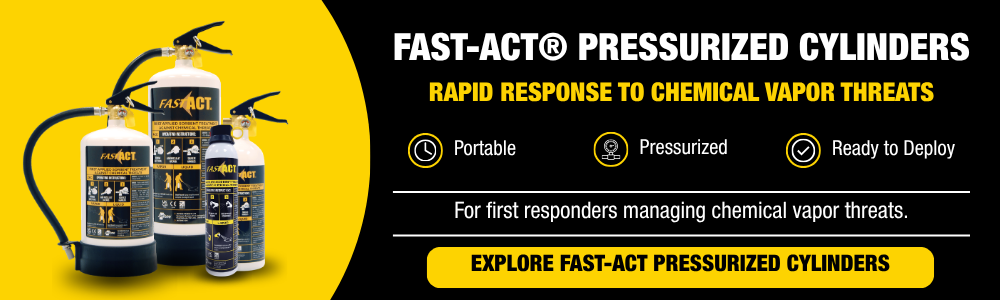
These products are not intended to replace established HAZMAT procedures or technical decontamination operations. They provide responders with additional tools for addressing appropriate contamination during the early stages of an incident. What to look for in a real dry decontamination solution is an important consideration for any Fire or HAZMAT team evaluating early-response chemical decontamination equipment, since not all products offer the same level of neutralization effectiveness as FAST-ACT
Dry decontamination is a bridge, not a replacement for the complete response.
How Should Fire, EMS, and HAZMAT Teams Coordinate During Early Decontamination?
Early decontamination is only one part of the response. What happens next matters just as much.
When an exposed patient moves from Fire or HAZMAT personnel to EMS, the receiving crew needs to know what happened, what substance is suspected, whether decontamination occurred, and what contamination may remain. That information should then travel with the patient to the hospital.
A clear handoff can include:
- Suspected chemical or hazard
- Route of exposure
- Number of exposed individuals
- Patient condition
- Decontamination performed
- Products or methods used
- Remaining contamination concerns
- Estimated time of arrival
- Whether additional patients are expected
Communication and alignment gaps in multi-agency HAZMAT drills repeatedly surface in exercises involving fire, EMS, and hospitals, not because of a lack of effort, but because the underlying training is fragmented across agencies that bring their own protocols, terminology, and command structures. The most common coordination pitfalls between hospitals and first responders are documented, and most are preventable with pre-established protocols and joint training.
The objective is to prevent each stage of the response from operating independently. Fire and HAZMAT teams should know what information EMS needs. EMS should know what the hospital needs. Hospitals should understand what information may be available from the field and what additional precautions may be necessary when a potentially contaminated patient arrives. The earlier that communication begins, the more time each part of the response has to prepare.
How Can Fire and HAZMAT Teams Train for Early Decontamination?
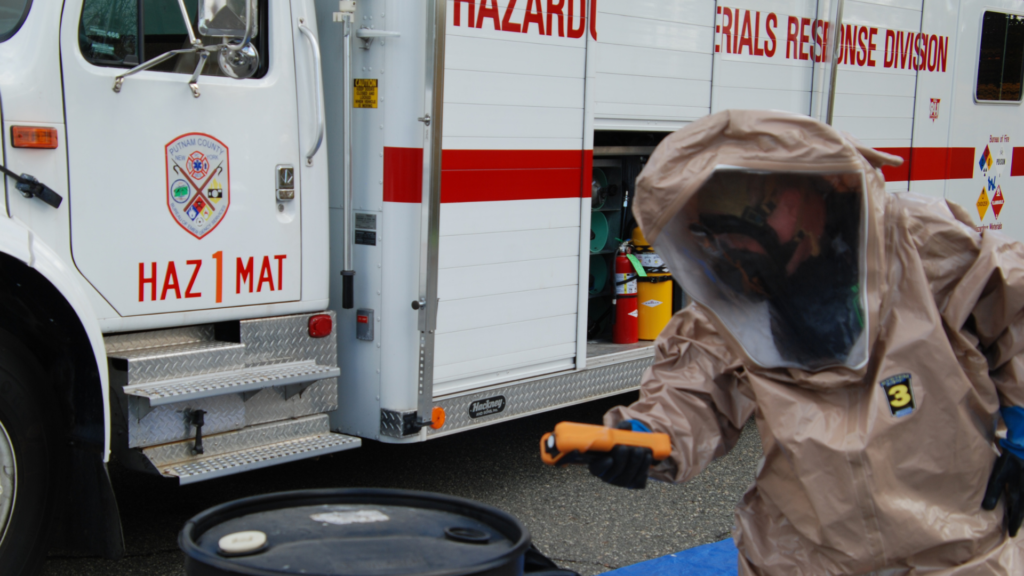
Having dry decontamination equipment available is only part of preparedness. Responders also need to know when and how it fits into their existing response procedures.
HAZMAT training gaps across U.S. fire departments are significant, with 60% of departments providing HAZMAT response but not formally training all personnel, making HAZMAT one of the top identified training needs across all department sizes. Decontamination as the top unmet training need among first responders was confirmed in a nationwide survey across all 50 states, with decontamination of apparatus and equipment cited as the single most requested training topic at 7.21%, followed by PPE use at 7.01%.
Exercises can incorporate early decontamination into existing HAZMAT scenarios by practicing:
- Scene recognition: identifying a potential chemical hazard and conducting the initial size-up
- Responder protection: determining appropriate PPE and establishing control zones
- Resource activation: requesting HAZMAT, EMS, and other resources early
- Patient management: determining how exposed individuals will be managed while full decontamination is established
- Early decontamination: practicing appropriate dry decontamination procedures
- Handoff: communicating exposure and decontamination information to EMS
- Hospital notification: ensuring the receiving facility receives relevant information before arrival
Repeating this sequence helps establish a common process across the response. Training should also extend beyond the fire station. Communication as the shared mission in joint fire-EMS-hospital drills was the primary finding from a coordinated chemical spill exercise at Lakeland Hospital in Michigan. The exercise coordinator noted that firefighters or paramedics may go through most of their career without seeing a real chemical incident, making practice and repetition essential.
Multi-agency decontamination drills building operational muscle memory was demonstrated at a large-scale University of Notre Dame exercise coordinating four local hospitals alongside fire and EMS, including live patient decontamination corridors, showing how realistic joint training translates directly into readiness. Annual emergency management training that brings all three disciplines together around shared protocols is one of the most effective investments any response system can make before the next chemical incident occurs.
Knowledge scores nearly doubling after chemical mass-casualty training, from an average of 41.72 to 77.96, confirms that training has measurable and significant impact on first receiver readiness across all three disciplines. Preparedness improves when the response is practiced, not just written into an SOP.
Preparing for the First Minutes of a Chemical Incident
The early stages of a chemical incident are rarely simple. Responders may be working with incomplete information while managing patient needs, protecting personnel, establishing control zones, activating additional resources, and preparing for decontamination.
Full technical decontamination remains an important part of the response, but it may take time to establish. That makes early preparedness important. Dry decontamination as a bridge before full decon is established can support that process by providing a portable option for appropriate chemical contamination when comprehensive systems are not yet in place.
The most effective response is not built around one product or one agency. It is built around training, equipment, communication, and coordination across the entire response chain. How Fire, HAZMAT, EMS, and hospitals coordinate across that chain, understanding each agency’s role and how early decisions ripple through every stage, is what ultimately determines whether the response is controlled or chaotic.
Join the Conversation
On September 4, FAST-ACT brought together hospital, EMS, and HAZMAT experts for a live panel discussion on exactly these challenges.
The panel covered early decontamination decision-making, the most common coordination gaps between disciplines, how dry decontamination fits into existing response protocols, what a common standard across all three disciplines looks like in practice, and more.
If you missed the live session, the recording is now available. Contact the FAST-ACT team to learn more about how dry decon fits into your agency’s chemical incident response protocols, go over FAST-ACT test reports in depth, or to schedule a demonstration for your team.
About Timilon Corporation:
Timilon Corporation is the manufacturer of FAST-ACT®, a proprietary formulation of non-toxic high-performance specialty materials effective at neutralizing a wide range of toxic chemicals with the added capability to destroy chemical warfare agents. The FAST-ACT technology is utilized by leading defense agencies, chemical industrial companies, first responders and HAZMAT teams to quickly and safely eliminate chemical hazards. For more information, reach out to Leticia Menzzano, Marketing Manager, lmenzzano@timilon.com.
FAQs
Can dry decontamination replace technical HAZMAT decontamination?


No. Dry decontamination is an early-response option that can serve as a bridge while more comprehensive decontamination capabilities are established. It does not replace established HAZMAT procedures or technical decontamination when those are required.
What FAST-ACT products can support early HAZMAT decontamination?
FAST-ACT offers several dry decontamination solutions for first responders, including the Operational Dry Decontamination Kit, Decontamination Mitts, Decontamination Wipes, and 400G Pressurized Cylinder. Different products are designed for different applications and exposure scenarios. Contact our team to see which FAST-ACT products meet your teams needs.
Can FAST-ACT be used for whole-body decontamination?
FAST-ACT's 400G Pressurized Cylinder provides a portable option for addressing larger areas and supporting whole-body decontamination when appropriate. The appropriate FAST-ACT solution depends on the type and extent of contamination.
How can Fire and HAZMAT teams prepare for early decontamination?
Teams can incorporate early decontamination into HAZMAT drills and SOPs, practice equipment deployment, establish communication procedures with EMS and hospitals, and conduct multi-agency exercises that include patient movement and handoffs.
What role does dry decontamination play before full decontamination is established?
Dry decontamination can provide a portable, waterless option for appropriate chemical contamination during the early stages of an incident. It can help bridge the period between initial exposure and the establishment of more comprehensive decontamination operations.