

FAST-ACT Joins Baptist Health for a City-Wide Emergency Preparedness Exercise in Texas
In October, the FAST-ACT® team joined Baptist Health in Texas for a city-wide emergency preparedness exercise. The dry decontamination training and product demonstration brought together healthcare professionals, law enforcement, fire, HAZMAT, and EMS personnel to practice a coordinated response to chemical incidents.
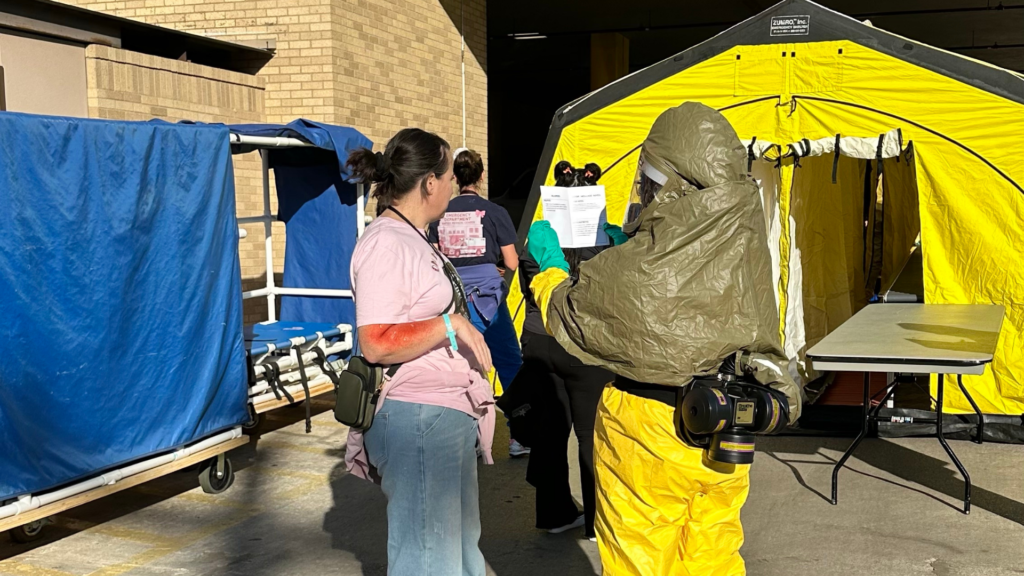
The session was hands-on. Participants worked through scenarios and saw how FAST-ACT dry decontamination can be put into action within minutes, without water or extensive setup.
The team demonstrated several formats:
- Decontamination Mitts and Wipes: targeted decontamination of skin, surfaces, and equipment
- 400G Pressurized Cylinders: a portable format for vapor and broader-area applications
- Customizable kits: portable systems built around an agency’s response needs
- Dry decontamination powder: for spill response and surface contamination
Why Do Multi-Agency Decontamination Exercises Matter?
A chemical incident moves through several agencies. Fire and HAZMAT teams manage the scene, EMS handles patient care and transport, and the hospital receives the patient. The gaps between those stages are where problems tend to appear.
Multi-agency HAZMAT drills repeatedly expose gaps in communication, unclear command roles, and inconsistent procedures, often because each agency trains with its own protocols and terminology. Joint exercises surface those gaps before a real incident does.
Practice also matters because real chemical incidents are rare. After a joint drill with a Michigan hospital, organizers noted that firefighters and paramedics may go most of their careers without seeing a real chemical incident. A large exercise at the University of Notre Dame that included four local hospitals alongside fire and EMS showed that training together builds muscle memory across disciplines.
Training also produces measurable results. In one simulation study, knowledge scores rose from 41.72 to 77.96 after chemical mass-casualty training, with improved confidence in PPE selection, zone setup, and decontamination.
Dry decontamination supports the early-response window, the period between exposure and the establishment of full decontamination. It does not replace technical or wet decontamination, and it complements established HAZMAT procedures. FAST-ACT requires no water and can be used as a standalone method.
Whether dry or wet decontamination is right depends on the substance, the environment, and the resources available. For hospitals, beginning dry decontamination before full decon is established helps manage contamination while the broader response is organized. Exercises like this one give healthcare, fire, HAZMAT, and EMS teams a shared view of how that works in practice.
How Can Your Team Schedule a FAST-ACT Demonstration?
FAST-ACT works with hospitals, fire departments, HAZMAT teams, EMS agencies, and law enforcement to bring hands-on dry decontamination training to their own facilities. Annual emergency management training that includes decontamination scenarios helps teams act under pressure when an incident occurs.
About Timilon Corporation:
Timilon Corporation is the manufacturer of FAST-ACT®, a proprietary formulation of non-toxic high-performance specialty materials effective at neutralizing a wide range of toxic chemicals with the added capability to destroy chemical warfare agents. The FAST-ACT technology is utilized by leading defense agencies, chemical industrial companies, first responders and HAZMAT teams to quickly and safely eliminate chemical hazards. For more information, reach out to Leticia Menzzano, Marketing Manager, [email protected].
FAQs
What was the FAST-ACT and Baptist Health exercise?


In October, FAST-ACT joined Baptist Health in Texas for a city-wide emergency preparedness exercise. The dry decontamination training and product demonstration gave participants hands-on experience with how dry decontamination works in a chemical response.
Why is hands-on decontamination training important?
Real chemical incidents are rare, so many responders go years without seeing one. Hands-on practice builds familiarity with the equipment and the response sequence, and joint drills show where communication between agencies breaks down before a real incident does.
How often should teams train on chemical response and decontamination?
OSHA’s HAZWOPER standard calls for annual refresher training or demonstrated competency for emergency responders. Many agencies also run joint exercises with their EMS, fire, HAZMAT, and hospital partners throughout the year.
Who should be trained on dry decontamination?
Anyone who may be among the first to encounter a chemical exposure, including hospital emergency department staff, EMS crews, fire and HAZMAT teams, and law enforcement. Industrial facilities and other organizations that handle hazardous chemicals can benefit as well.
What is FAST-ACT dry decontamination?
FAST-ACT Dry decontamination uses a patented formula to decontaminate, contain, and neutralize hazardous chemicals, no water needed.