

Fentanyl Decontamination and Responder Safety: Why Federal Designation Matters for First Responders
In December 2025, the White House issued an executive order designating illicit fentanyl and its core precursor chemicals as a weapon of mass destruction (WMD). This designation reflects a growing federal acknowledgment that fentanyl is not only a driver of the opioid crisis, but also a serious hazardous materials threat to first responders, including law enforcement, fire, EMS, and other public safety personnel.
For those operating on the front lines, encounters with synthetic opioids such as fentanyl are increasingly common during overdose calls, investigations involving illicit drugs, and responses in public spaces. Understanding why this designation matters—and what it means for fentanyl decontamination and responder safety—is critical.
Fentanyl Decontamination and Responder Safety: Understanding the Federal Designation
The executive order cites fentanyl’s extreme potency, lethality, and potential for mass harm. Even trace amounts of fentanyl powder can present exposure risks during routine law enforcement and emergency response activities. According to federal guidance, fentanyl pills and powders are often encountered alongside drug paraphernalia, contaminated packaging, and other materials tied to illicit opioids.
This designation aligns fentanyl incidents with existing hazardous materials standards, reinforcing the need for structured response protocols, risk assessments, and decontamination planning—particularly for law enforcement personnel and emergency responders who may unknowingly encounter fentanyl during daily operations.
The Risk to First Responders
Unlike the general public, first responders face repeated occupational exposure risks, including:
- Handling unknown substances during searches or clean-up operations
- Responding to overdose calls involving illicit drug exposure
- Contact with contaminated clothing, surfaces, or vehicles
- Potential secondhand fentanyl exposure during evidence processing
The Centers for Disease Control and Prevention (CDC) has issued public health guidance emphasizing that fentanyl exposure is a legitimate occupational hazard for emergency responders and public safety personnel.
While personal protective equipment (PPE) remains an important control measure, PPE alone does not address environmental contamination or post-incident clean-up. Effective fentanyl decontamination requires additional planning, tools, and standard safety operation procedures.
Fentanyl Decontamination and Responder Safety: Managing Unknown Powders and On-Scene Risk
One of the most challenging aspects of fentanyl response is uncertainty. Many incidents begin with an unknown powder or residue, requiring an immediate on-scene risk assessment to determine the next steps. Agencies such as the U.S. Drug Enforcement Administration (DEA) have highlighted the importance of treating unknown substances as potentially hazardous until properly identified.
Learn more about handling unknown substances: https://fast-act.com/what-is-your-unidentified-hazardous-materials-response-strategy/
This reality reinforces the need for:
- Field testing and detection capabilities
- Clear risk assessments before handling materials
- Consistent procedures for containment and decontamination
Without a structured approach, responders’ risk secondary contamination, prolonged facility shutdowns, and unintended exposure across teams or emergency departments following transport.

Fentanyl Decontamination and Responder Safety with FAST-ACT
FAST-ACT supports first responders by providing decontamination products and process-driven solutions designed specifically for hazardous materials incidents involving fentanyl and illicit opioids and its derivatives.
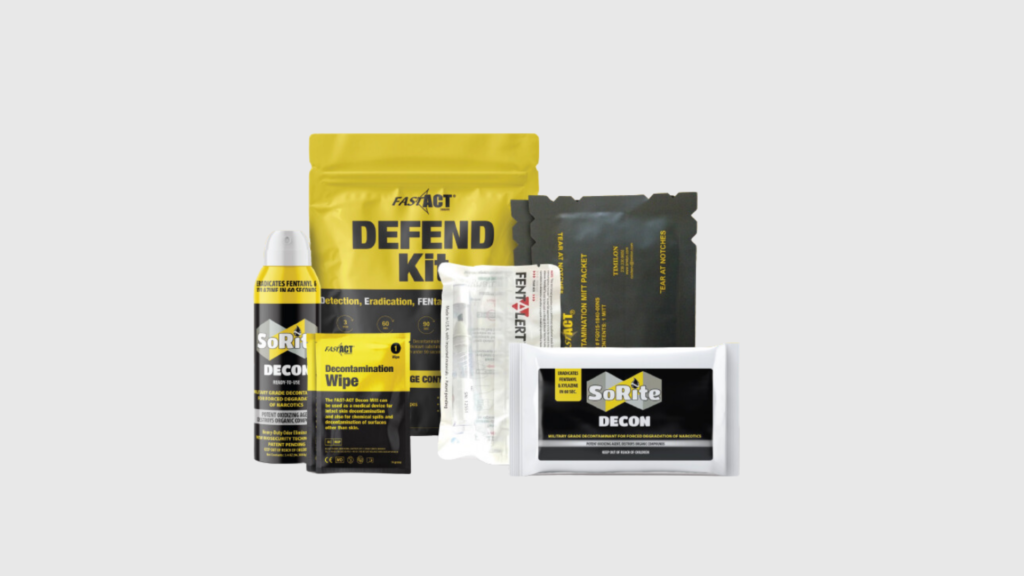
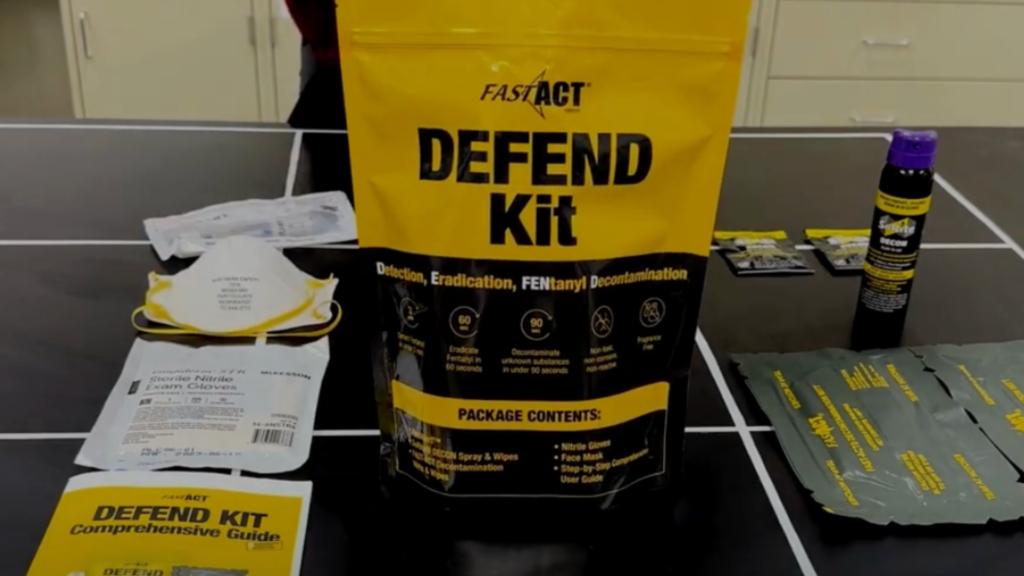
The DEFEND Kit—which stands for Detection, Eradication, and FENtanyl Decontamination—was developed to address the operational challenges faced by law enforcement and emergency responders when dealing with unknown substances and confirmed fentanyl exposure.
The DEFEND Kit emphasizes:
- Operator-centric design, supporting ease of use in high-stress environments
- Integrated detection and oxidation/decontamination steps
- Clear methodology aligned with responder workflows
- Support for safer clean-up operations following exposure incidents
Rather than relying solely on PPE, the DEFEND Kit provides a repeatable framework that aligns with modern fentanyl decontamination and responder safety expectations.
Preparedness in a Changing Threat Landscape
The federal designation of fentanyl as a weapon of mass destruction reinforces what first responders already experience in the field: fentanyl incidents are no longer isolated drug events—they are hazardous materials responses with real public safety implications.
As overdose awareness, emergency notifications, and illicit drug threats continue to evolve, preparedness means having tested processes, risk assessment tools, and decontamination strategies in place before exposure occurs.
To learn more about testing, evaluation, and fentanyl decontamination resources designed to support first responders and law enforcement, reach out to the FAST-ACT team to protect those who protect others.
About Timilon Corporation:
Timilon Corporation is the manufacturer of FAST-ACT®, a proprietary formulation of non-toxic high-performance specialty materials effective at neutralizing a wide range of toxic chemicals with the added capability to destroy chemical warfare agents. The FAST-ACT technology is utilized by leading defense agencies, chemical industrial companies, first responders and HAZMAT teams to quickly and safely eliminate chemical hazards. For more information, reach out to Leticia Menzzano, Marketing Manager, lmenzzano@timilon.com.
FAQs
What role does FAST-ACT play in fentanyl decontamination and responder safety?


FAST-ACT supports first responders, law enforcement, and emergency responders by providing decontamination products and structured processes designed for hazardous material incidents involving fentanyl and other illicit opioids.
Why is fentanyl decontamination important for law enforcement and first responders?
Fentanyl decontamination is critical because fentanyl powder, pills, and residues can contaminate surfaces, equipment, vehicles, and clothing. Without proper decontamination, first responders face ongoing exposure risks, including secondary or delayed exposure.
What is the DEFEND Kit and how does it support fentanyl response?
The DEFEND Kit—Detection, Eradication, and FENtanyl Decontamination—is a comprehensive fentanyl decontamination solution developed by FAST-ACT. It provides a process-driven framework that guides operators through detection, neutralization, and clean-up of fentanyl and its derivatives, supporting responder safety at every step.
How is the DEFEND Kit designed for first responders?
The DEFEND Kit features an operator-centric design, developed specifically for the realities faced by law enforcement personnel and emergency responders. Each component is intended to be intuitive, efficient, and compatible with standard safe operation procedures used in hazardous materials response.
How does FAST-ACT support on-scene risk assessment and unknown powders?
FAST-ACT solutions are built to support on-scene risk assessment by providing tools and processes for handling unknown powdery substances safely. Treating unknown materials as potentially hazardous is a key principle of fentanyl decontamination and responder safety.