

Dry Decontamination Isn’t Always the Finish Line: Where It Fits in Fire & HAZMAT Response
When Fire and HAZMAT teams arrive at a chemical incident, the response may already be underway, but the full technical decontamination operation may not yet be established.
Responders must quickly assess the hazard, protect themselves, establish appropriate control zones, determine response objectives, and begin coordinating the resources needed to control the incident. At the same time, contaminated people, equipment, and surfaces may still require immediate attention.
Chemical identification isn’t always immediate, FEMA notes that field detection technologies can identify many chemicals, but the number in use across the United States means responders may not always be able to identify an agent right away. Until more information is available, responders must account for potential toxicity and select appropriate protective measures. According to ATSDR unidentified chemical guidance, worst-case toxicity must be assumed until the substance is confirmed, including severe local and systemic effects.
This creates an important window in the response: the period between recognizing and controlling the incident and establishing full technical decontamination.
Dry decontamination can be another tool during that early-response window when appropriate. It does not replace technical or wet decontamination. Instead, it can help manage contamination while the broader response is being established.
What Is the Fire and HAZMAT Team’s Role in a Chemical Incident?
Fire and HAZMAT teams have responsibilities that extend beyond identifying a chemical or containing a release. Their response may include hazard assessment, air monitoring, establishing control zones, selecting appropriate PPE, controlling the release, managing contamination, and coordinating decontamination.
HAZMAT Technician responsibilities include chemical identification, air monitoring, technical entry, product containment, vapor suppression, sampling, technical decontamination, and risk assessment, distinguishing technician-level response from the defensive activities performed by Operations-level responders. According to NFPA 472 and NFPA 1072, a single breach in decontamination procedures can compromise the entire operation and endanger personnel in clean areas.
HAZMAT control zone establishment, Hot, Warm, and Cold, protects personnel and controls contamination spread. FEMA notes that zone boundaries should be based on sampling, monitoring, and potential routes of contaminant dispersion. The objective is to establish enough control over the incident to safely perform the work that follows.
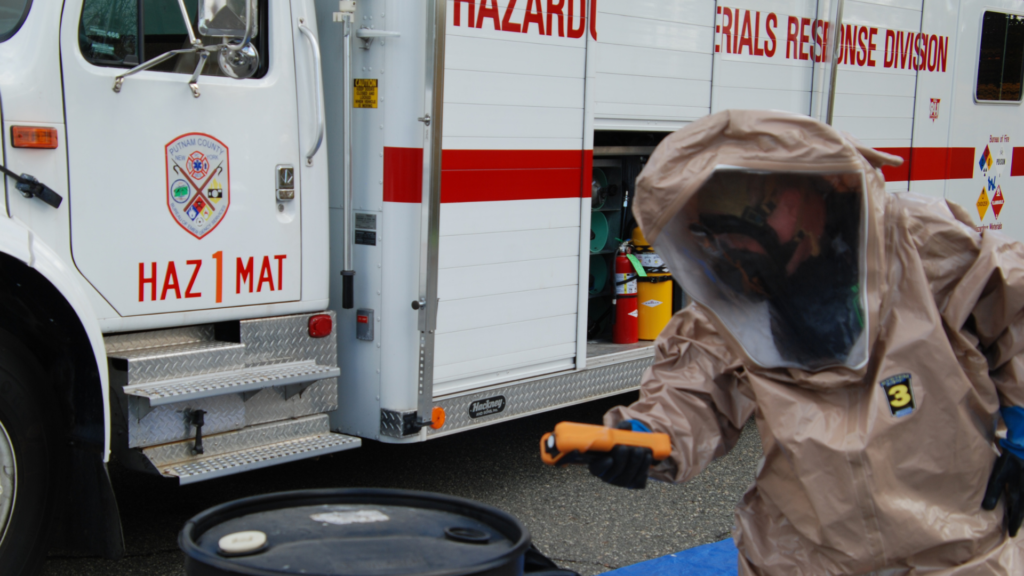
Why Does Technical Decontamination Take Time to Establish?
Technical decontamination requires more than a hose line and a designated area.
A formal decontamination operation may require personnel, equipment, PPE, planning, coordination, monitoring, and a defined decontamination corridor. According to NFPA 472, the Warm Zone provides the controlled area where personnel and equipment decontamination and Hot Zone support activities take place, and technical decontamination must be fully operational before entry begins.
Two decon lines established simultaneously, one for personnel and one for victims, can require 20 to 30 people. Full CBRN setup can take about an hour following best practices. If a community must wait for a remote HAZMAT team, setup is delayed even longer, and while that is taking place, chemicals are continuing to harm victims.
The challenge is that contamination does not necessarily wait for the technical operation to be ready. A patient may already require decontamination. A responder may have been exposed during rescue or containment activities. Contaminated PPE or equipment may need to be managed before it moves farther through the response area. This is where the early-response period becomes important.
What Is Emergency and Interim Decontamination?
Emergency decontamination and technical decontamination serve different purposes.
NFPA defines emergency decontamination as the immediate reduction of contamination for individuals in potentially life-threatening situations without the formal establishment of a contamination corridor, recognizing that a formal corridor is not always available when victims need immediate attention. According to Firehouse/Robert Burke, forcing victims to wait for technical decon setup makes no sense, protection should include emergency decontamination for contaminated victims, not just PPE for responders.
Interim decontamination can help bridge the period between the initial response and the arrival or establishment of technical resources. Research on mass casualty decontamination sequencing found that dry and wet approaches can serve as components of a larger, sequential decontamination process. Research on combining improvised methods found that the UK’s shift toward a more rapidly deployable Initial Operational Response framework, away from mass decontamination units requiring substantial setup time, was driven by evidence that early improvised methods can quickly decontaminate casualties before specialist resources arrive.
Where Does Dry Decontamination Fit Into HAZMAT Response?
Dry decontamination provides another potential option during the early-response window.
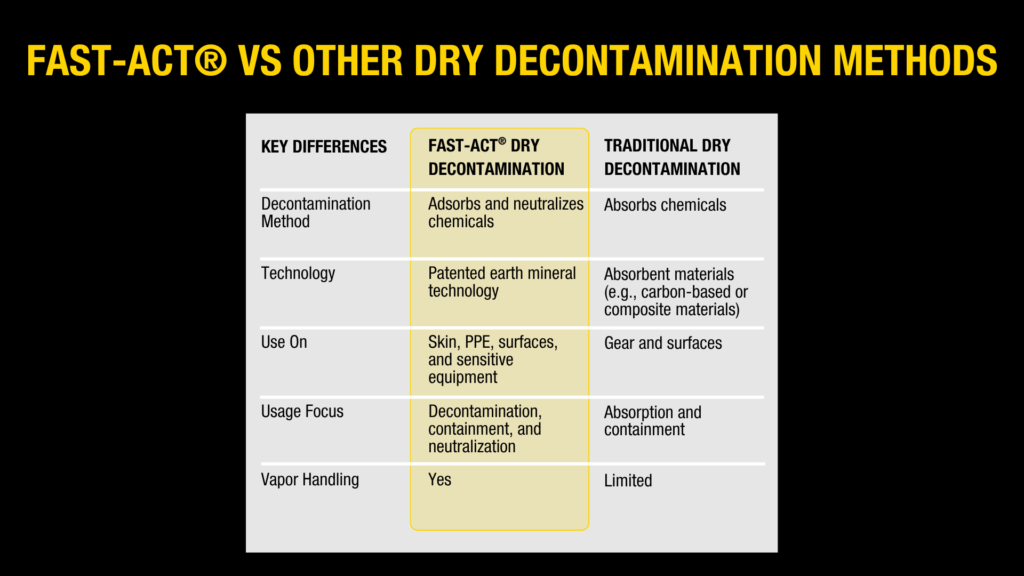
A controlled human volunteer study found that dry decontamination reduced skin contamination under all test conditions, blotting combined with rubbing produces the greatest reduction. The FAST-ACT Decontamination Mitt and Decontamination Wipes are designed around exactly this principle, providing a portable, hands-on option for targeted dry decontamination of skin and surfaces without requiring water or complex setup. Mitts and Wipes are CE certified as Class I medical devices for use on skin and surfaces in the European Union.
Additional research found that combining dry and wet decontamination resulted in lower simulant recovery than either method alone, supporting the idea that different methods can serve different roles within an overall response.
Whether dry or wet decontamination is right for the situation depends on the chemical, exposure, and available resources. Not all dry decontamination solutions offer the same neutralization effectiveness as FAST-ACT, an important consideration for any Fire or HAZMAT agency evaluating early-response options.
The goal is not to replace technical decontamination. It is to give responders an option for the period before that comprehensive process is ready.
How Can HAZMAT Teams Reduce Cross-Contamination?
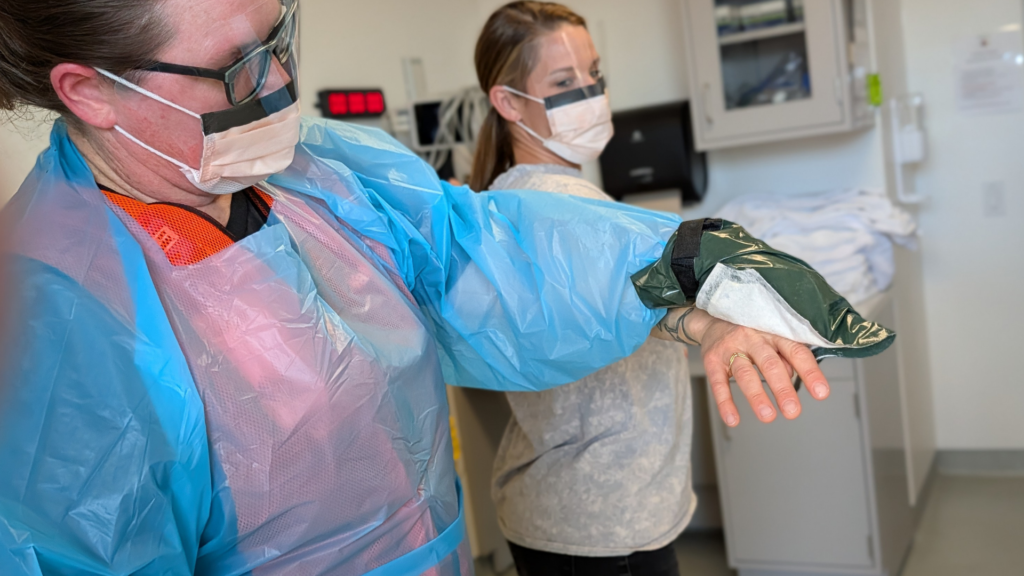
A chemical incident does not end when a contaminated person leaves the immediate release area. Contamination can transfer through people, PPE, equipment, tools, and other surfaces. Maintaining zone integrity and controlling movement between areas are therefore important parts of HAZMAT operations. OSHA’s HAZWOPER standard requires employers to establish decontamination procedures for workers and contaminated equipment, designed to minimize exposure to uncontaminated personnel and equipment.
For Fire and HAZMAT teams, this means considering contamination at every transition point:
- From the Hot Zone to the Warm Zone
- From the decontamination corridor to the Cold Zone
- From contaminated equipment to staging areas
- From the incident scene to transport vehicles
- From the field to the receiving hospital
Secondary contamination risks for hospital staff, including ED evacuations and injuries to healthcare personnel, are among the most documented consequences of contamination traveling through the response chain unaddressed. Early or interim decontamination, when appropriate, can reduce what is carried into each downstream stage of the response. It does not eliminate the need for established technical decontamination procedures. Instead, it can help manage contamination before the next stage of the response.
Why Does Vapor Management Matter During HAZMAT Response?
Chemical incidents can involve both liquid and vapor hazards, making vapor management an important consideration for HAZMAT teams.
FEMA’s zone boundary guidance emphasizes that control zones should account for potential routes of contaminant dispersion, adjusted based on sampling, monitoring, and evaluation of the incident. Research detecting VOCs in warm zones during fire events found sustained vapor levels in areas where decontamination personnel may be working, highlighting that vapor hazards can persist in the decontamination zone itself.
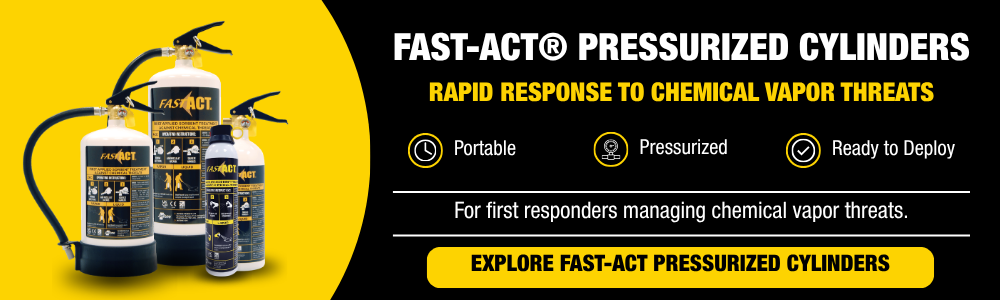
For certain chemical incidents, vapor suppression may therefore be incorporated into the broader response strategy. The FAST-ACT 400G Pressurized Cylinder provides a portable format for rapid vapor suppression when appropriate, designed for dynamic HAZMAT environments where setup time is limited.
These technologies should be considered as part of a broader HAZMAT strategy that includes appropriate PPE, monitoring, control zones, containment, and technical decontamination.
How Does Fire and HAZMAT Coordinate with the Receiving Hospital?
Fire and HAZMAT responsibilities can extend beyond the incident scene when contaminated patients require medical treatment.
Advance hospital notification gives medical personnel time to prepare before patients arrive, FEMA identifies this as an important component of chemical incident response because it allows facilities to prepare before patients arrive. Common first responder-to-hospital pitfalls, including failing to communicate what decontamination has occurred, are among the most preventable failures in the chemical response chain.
Information communicated during the handoff may include:
- The suspected or identified chemical
- The type of exposure
- The patient’s contamination status
- Decontamination already performed
- Potential residual contamination
- Any additional information the hospital should know before arrival
This communication helps ensure that early or interim decontamination is not mistaken for completed decontamination. Hospital decontamination preparedness gaps, including receiving patients without prior notification, remain among the most consequential vulnerabilities in the chemical response chain.
Where Does FAST-ACT Fit into Fire & HAZMAT Response?
FAST-ACT provides dry decontamination technology that can support chemical response during the early stages of an incident.
FAST-ACT Decontamination Mitts and Decontamination Wipes provide options for targeted decontamination of skin, surfaces, and sensitive equipment, including PPE, monitoring instruments, and tools that may have been exposed during hot zone operations. The Mitts and Wipes are CE certified as Class I medical devices for use on skin and surfaces in the European Union, and the wipes support removal of radiological particles in addition to chemical contamination, making them relevant across a broader range of HAZMAT incident types.
The FAST-ACT 400G Pressurized Cylinder provides a portable format for larger-area applications and appropriate vapor response scenarios, with an average discharge time of approximately 9.9 seconds, allowing HAZMAT teams to rapidly address chemical vapor threats and surface contamination without requiring water, mixing, or complex setup procedures.
The science behind FAST-ACT’s technology explains why its neutralization-based formulation is effective during the early response window before comprehensive systems are in place.
These tools are not intended to replace complete technical or wet decontamination. They support the early-response bridge between initial contamination and the next stage of decontamination. For Fire and HAZMAT teams, having additional decontamination options available helps agencies build a response strategy around the realities of the incident rather than relying on a single method for every scenario.
How Can Fire and HAZMAT Teams Prepare for Early Decontamination?
The time to determine how emergency, interim, dry, and technical decontamination fit into a response is before an incident occurs.
Response plans should establish:
- Who is responsible for emergency and technical decontamination
- What responders are trained and authorized to perform
- What equipment is available
- How Hot, Warm, and Cold Zones will be established
- How contamination will be managed during the initial response
- How dry or interim decontamination fits within established procedures
- How contaminated patients and equipment will be managed
- How Fire/HAZMAT will coordinate with EMS
- How receiving hospitals will be notified
- How early decontamination transitions into comprehensive decontamination
OSHA’s HAZWOPER requirements emphasize established emergency response plans, decontamination procedures, training, PPE, communication, and coordination. Annual emergency management training incorporating early decontamination decision-making ensures HAZMAT teams are prepared for the full response window before the next incident occurs. Preparedness is ultimately about knowing what options are available before responders encounter a chemical release.
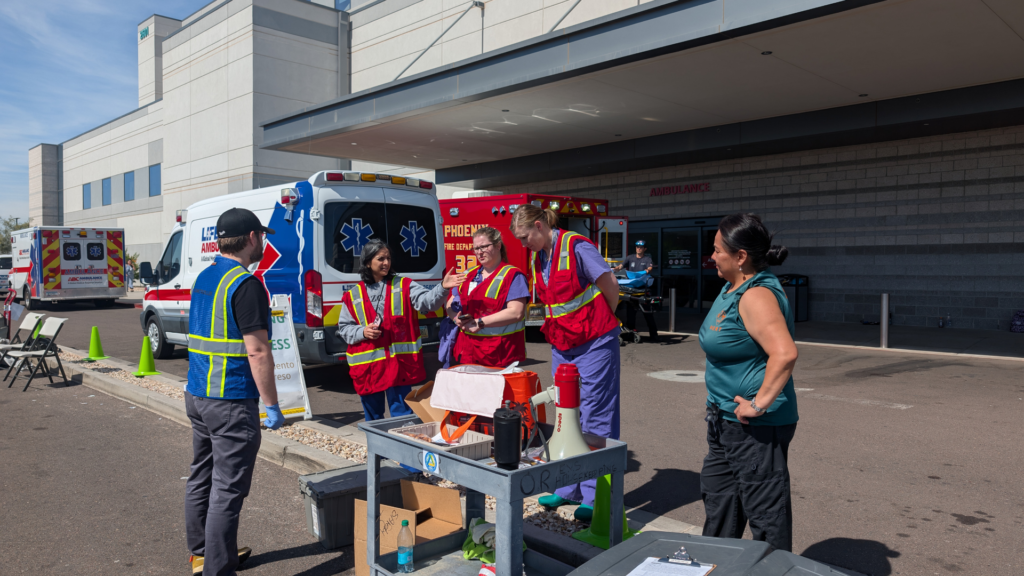
Dry Decontamination for Fire and HAZMAT Teams
Fire and HAZMAT teams must manage multiple elements of a chemical incident at once: hazard identification, responder protection, control zones, containment, contamination management, decontamination, and communication with downstream responders and healthcare facilities.
Technical decontamination remains an essential part of that process. But there can be a period between initial response and the establishment of a comprehensive decontamination operation. When appropriate, emergency and interim decontamination can help manage contamination during that period. Dry decontamination is one tool that can support this early-response window. First responder health and safety depends on having clearly defined options at every stage, not just when the technical operation is fully established.
The goal is not to choose between dry and technical decontamination. It is to understand where each fits within the overall response and have appropriate options available when the incident demands them.
The next stage of the response moves into the hospital environment, where receiving facilities must be prepared to assess potentially contaminated patients, protect staff and infrastructure, and continue the decontamination and treatment process.
Continue the Conversation
Reach out to our team to receive the full panel discussion featuring industry experts on rapid decontamination and coordinated response across EMS, hospitals, and HAZMAT.
About Timilon Corporation:
Timilon Corporation is the manufacturer of FAST-ACT®, a proprietary formulation of non-toxic high-performance specialty materials effective at neutralizing a wide range of toxic chemicals with the added capability to destroy chemical warfare agents. The FAST-ACT technology is utilized by leading defense agencies, chemical industrial companies, first responders and HAZMAT teams to quickly and safely eliminate chemical hazards. For more information, reach out to Leticia Menzzano, Marketing Manager, lmenzzano@timilon.com.
FAQs
What is emergency decontamination in HAZMAT response?


Emergency decontamination is the immediate reduction of contamination when urgent action is needed before a formal decontamination corridor can be established.
What is interim decontamination?
Interim decontamination helps bridge the period between the initial response and the arrival or establishment of technical decontamination resources.
Where does dry decontamination fit into HAZMAT response?
HAZMAT teams can maintain zone integrity, control the movement of personnel and equipment, and follow established decontamination procedures to help prevent contamination from reaching clean areas.
Does dry decontamination replace technical decontamination?
No. Dry decontamination is an additional early-response tool that can help manage contamination while comprehensive decontamination is being established. Technical or wet decontamination may still be required depending on the chemical, exposure, and response procedures.
How does FAST-ACT support Fire and HAZMAT teams?
FAST-ACT provides dry decontamination and vapor suppression technologies that can give Fire and HAZMAT teams additional options for managing chemical contamination during the early stages of an incident. FAST-ACT products are not intended to replace complete technical or wet decontamination.