

Where Dry Decontamination Fits in Hospital Chemical Response
When a contaminated patient arrives at a hospital, the emergency department may need to respond before its full decontamination operation is ready. Patients may arrive by EMS, private vehicle, or without advance notification, creating an immediate need to protect staff, other patients, and the facility while the broader response is organized. This early window is where dry decontamination can provide an additional response option.
Dry decontamination is not a replacement for comprehensive hospital decontamination. It is another option that can help hospitals manage contamination during the initial stages of a response while personnel and equipment capabilities are being established. Hospital decontamination procedures, including zones, triage, and the importance of early response, establish the framework that dry decontamination supports during that critical early window.
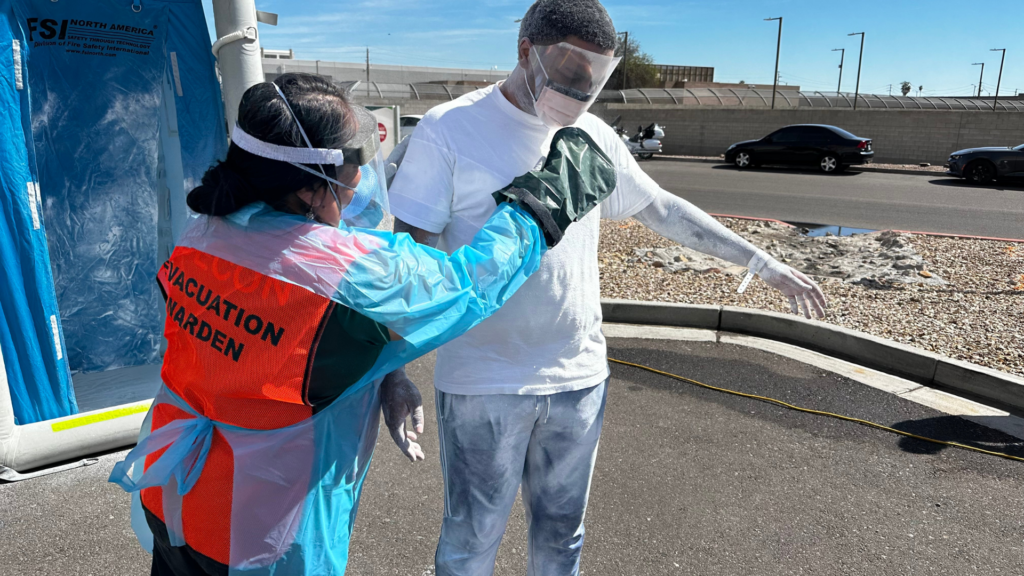
What Happens When a Contaminated Patient Arrives at the Hospital
Hospitals cannot always assume that a contaminated patient will arrive through a fully coordinated EMS and HAZMAT response. Self-presenting contaminated patients may arrive after an incident with little or no advance notification. A scenario documented during the 1995 Tokyo subway sarin attack, when more than 4,000 people reached hospitals by private vehicle or on foot before coordinated hospital decontamination was established. This makes preparedness particularly important at the emergency department entrance and other points where patients may first enter the facility.
A survey of hospital safety officers found that 47% of responding hospitals had received an average of 2.4 chemically contaminated patients in a single year, yet only 55% of Washington State hospital-based emergency care facilities had protocols for handling medical facility contamination and potential evacuation arising during the management of contaminated patients.
According to CHEMM guidance for contaminated patient receiving, healthcare facilities should prepare for contaminated patients arriving unexpectedly and establish procedures for patient receiving, isolation, and decontamination. The goal is to recognize potential contamination quickly and prevent it from moving into areas of the hospital that were not designed to handle the hazard. Recognizing contamination at intake, before a patient moves deeper into the facility, is one of the most important and often undertrained capabilities in hospital chemical response.
Why Does Early Decontamination Matter?
Decontamination is time-sensitive. The longer a chemical remains on a person’s skin, clothing, or equipment, the longer the potential exposure can continue.
Research evaluating decontamination timing at 5, 15, 45, and 120 minutes after chemical exposure found that decontamination was significantly more effective when initiated at the earliest time point, with effectiveness decreasing measurably at each subsequent delay. According to NIH/StatPearls, chemical decontamination should begin within one minute of exposure when feasible, and that contamination can render a healthcare treatment site inoperable if decontamination is not initiated outside the patient treatment area.
CHEMM identifies several levels of patient decontamination, including emergency self-care, gross decontamination, and technical decontamination. Its guidance emphasizes that patient decontamination should not be delayed while waiting for a more advanced level of decontamination to become available.
This distinction is important for hospital preparedness. A hospital may be establishing its formal decontamination area while simultaneously managing a patient who needs immediate attention. Early decontamination can provide an additional step during that transition. How hospitals can begin dry decontamination before full decon is established is one of the most practically important preparedness questions any facility should address before an incident occurs.
The objective is not to choose between dry and wet decontamination. It is to have appropriate options available throughout the response.
What is the Risk of Secondary Contamination?
The concern extends beyond the contaminated patient. Research has documented cases in which contaminated patients resulted in secondary exposure to emergency department personnel and other healthcare workers. An ATSDR analysis of hazardous-substance events from 2003 to 2006 identified 15 incidents involving secondary contamination of medical personnel, resulting in injuries to at least 17 medical personnel, including 12 EMTs and five hospital personnel. Respiratory irritation was the most common injury sustained.
A separate analysis of 33,001 hazardous-substance events between 2007 and 2013 identified five incidents involving suspected secondary contamination in emergency departments, four of which resulted in evacuation or temporary shutdown of the facility. Research further found that nearly all ED evacuations were related to lack of early recognition rather than lack of a written protocol or dedicated decontamination equipment.
ED personnel injuries from secondary contamination can be prevented through proper victim decontamination procedures, good field-to-hospital communication, and appropriate PPE use, reinforcing that preparedness and communication, not just equipment, drive outcomes.
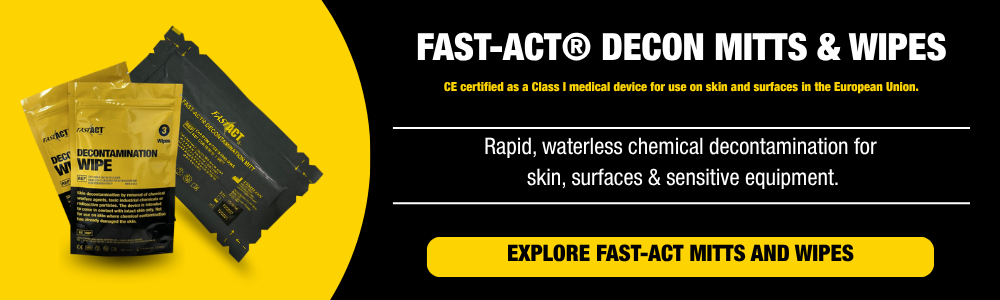
These events demonstrate why hospitals need to consider what happens between patient arrival and full decontamination. Preparedness is not only about having a decontamination system. It is also about having a plan for the minutes before that system is fully operational.
Is Dry Decontamination an Early-Response Tool?
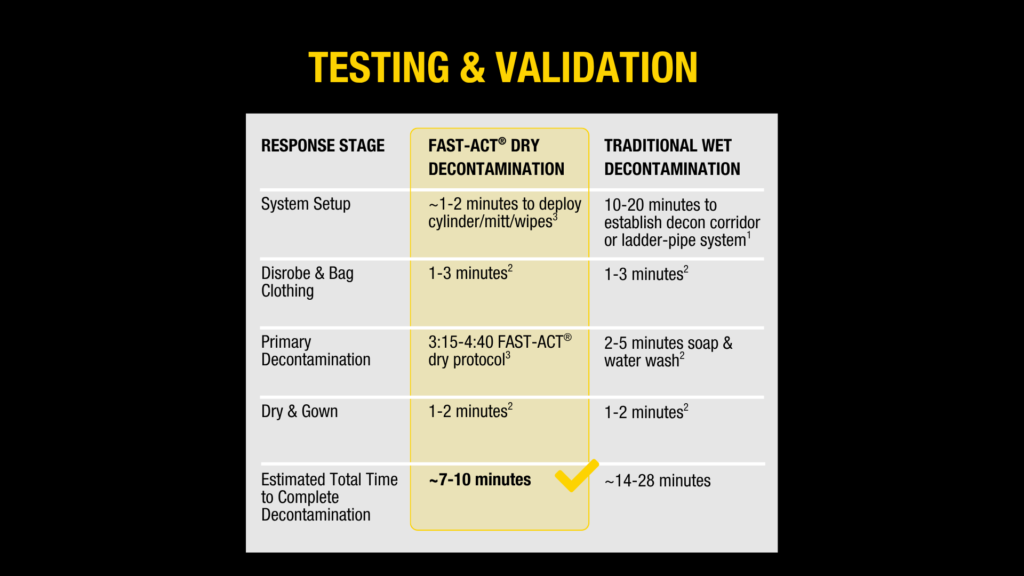
Dry decontamination can provide hospitals with a portable option for managing appropriate chemical contamination without waiting for a water-based system to be established.
Research in controlled volunteer trials found that dry decontamination reduced skin contamination under all tested conditions, with blotting combined with rubbing producing the greatest reduction. Combining dry and wet decontamination resulted in lower simulant recovery than either method alone, supporting the idea that dry and wet approaches serve different roles within a larger response rather than competing with each other. While research supports combining dry and wet approaches for maximum effectiveness, FAST-ACT’s neutralization-based formulation is also effective as a standalone dry decontamination method, neutralizing hazardous chemicals on contact without requiring water, making it a practical option when wet decontamination resources are not yet available or accessible.
A hospital’s response may involve several stages, depending on the contaminant, patient condition, available resources, and established procedures. Dry decontamination can be incorporated into that process alone, before, or alongside more comprehensive decontamination. Whether dry or wet decontamination is right for the situation depends on the chemical, patient condition, and available resources, and that decision should be addressed in hospital protocols before an active incident. Not all dry decontamination solutions offer the same level of neutralization effectiveness, an important consideration for any hospital evaluating early-response options.
FAST-ACT Dry Decontamination Solutions for Hospital Response
FAST-ACT provides dry decontamination products designed to support chemical response across a range of applications.
FAST-ACT Decontamination Mitts
FAST-ACT Decontamination Mitts provide a portable option for targeted decontamination of skin and surfaces, CE certified as a Class I medical device for use on skin and surfaces in the European Union. The Mitts are designed to be used directly where contamination needs to be addressed without requiring a water source, making them well suited for the early response window before full decontamination infrastructure is established.
FAST-ACT Decontamination Wipes
FAST-ACT Decontamination Wipes provide another portable option for targeted decontamination of skin, surfaces, and sensitive equipment where traditional water-based methods may not be appropriate, including monitoring instruments, PPE, and other operational touchpoints that may have been exposed during patient intake. The Wipes also support removal of radiological particles from skin and surfaces, making them relevant across a broader range of chemical and radiological incident types.
FAST-ACT 400G Pressurized Cylinder
For whole body application and appropriate vapor-response scenarios, the FAST-ACT 400G Pressurized Cylinder provides a portable format that can be deployed quickly, with an average discharge time of approximately 9.9 seconds, allowing hospital teams to rapidly address chemical vapor threats and patient contamination.
Together, these options give healthcare teams multiple formats for addressing chemical contamination depending on the situation and the area requiring treatment. The science behind FAST-ACT’s technology explains why its neutralization-based formulation is effective during the early response window, when the goal is rapid contamination reduction before comprehensive systems are in place.
How to Build Dry Decontamination Into Hospital Preparedness
Having the right equipment is only one part of preparedness.
Hospitals should determine where dry decontamination supplies will be stored, who is responsible for using them, and how they fit into the facility’s existing emergency response procedures. According to OSHA’s first receiver training requirements, hospital staff working in the decontamination zone must receive Operations Level training, a minimum of 8 hours covering hazard recognition, PPE use, zone setup, and decontamination procedures. A survey of U.S. Level 1 trauma centers found that only 6% had all necessary equipment required for safe decontamination, and only 36% of staff had received any HAZMAT training at all.
Training should also involve the teams that may interact with a contaminated patient first, including emergency department personnel, emergency preparedness teams, EMS partners, and other designated response personnel. Hospital chemical decontamination training exercises that simulate real-world scenarios help facilities identify practical gaps before an actual incident exposes them.
Exercises can help identify practical questions before an actual incident occurs:
- Where does a potentially contaminated patient enter the facility?
- Who identifies and communicates the contamination concern?
- Where are dry decontamination supplies located?
- Who is trained to use them?
- How will the hospital establish its full decontamination operation?
- How will information about decontamination performed before arrival be communicated?
- How will the response transition from early decontamination to comprehensive decontamination?
These decisions are easier to make during training than during an active chemical incident. Annual emergency management training incorporating hospital-specific chemical decontamination scenarios is one of the most effective investments any facility can make before the next incident occurs.
What Is The Role of Training and Coordination?
Hospital chemical preparedness extends beyond the emergency department. EMS, Fire/HAZMAT, emergency preparedness personnel, and hospital teams all play different roles in the response.
Training together can help establish a shared understanding of what decontamination has already occurred before a patient reaches the hospital, and what still needs to be done. Common coordination pitfalls between hospitals and first responders, including failure to communicate what decontamination has or has not occurred, are among the most preventable failures in the chemical response chain.
Frameworks such as PRISM and 15 ’til 50 can also help hospitals think about rapid response, patient surge, resource availability, and the importance of having equipment and procedures ready before an incident occurs. A hospital SOP for dry chemical decontamination provides a structured, actionable framework hospitals can use to integrate dry decontamination into their existing emergency response plans.
The goal is not to create another complicated layer of response. It is to make sure personnel understand what they can do immediately, what happens next, and how those actions connect to the hospital’s full decontamination plan.
Why Dry Decontamination Is Not the Finish Line?
A contaminated patient arriving at the hospital does not always mean the hospital’s complete decontamination system is already operational. That gap matters.
Dry decontamination can provide an additional tool for managing appropriate chemical contamination during the early stages of response, helping hospitals take action while comprehensive decontamination is being established. First responder health and safety, and the safety of hospital staff receiving potentially contaminated patients, depends on having clearly defined options available at every stage, not just when the full decontamination system is ready.
FAST-ACT is designed to work alongside established response procedures, giving healthcare teams portable dry decontamination options for skin, surfaces, sensitive equipment, larger-area applications, and appropriate vapor-response scenarios.
While FAST-ACT works well as part of a combined dry and wet decontamination approach, its neutralization-based formulation is also effective as a standalone dry decontamination method, neutralizing hazardous chemicals on contact without requiring water, making it a practical option when wet decontamination resources are not available or accessible.
The goal is not to replace comprehensive decontamination. It is to make sure hospitals have another tool available for the minutes when waiting may not be the best option.
Prepare Before the Patient Arrives
Hospital chemical preparedness starts before an incident occurs. Review your current decontamination procedures, identify where dry decontamination can fit into your response plan, train personnel on appropriate use, and coordinate those procedures with EMS and Fire/HAZMAT partners.
To learn more about FAST-ACT hospital decontamination solutions or schedule a demonstration for your facility or healthcare coalition, contact our team.
About Timilon Corporation:
Timilon Corporation is the manufacturer of FAST-ACT®, a proprietary formulation of non-toxic high-performance specialty materials effective at neutralizing a wide range of toxic chemicals with the added capability to destroy chemical warfare agents. The FAST-ACT technology is utilized by leading defense agencies, chemical industrial companies, first responders and HAZMAT teams to quickly and safely eliminate chemical hazards. For more information, reach out to Leticia Menzzano, Marketing Manager, lmenzzano@timilon.com.
FAQs
Where does dry decontamination fit in hospital chemical response?


Dry decontamination can be used during the early stages of a chemical response, including before or alongside traditional water-based decontamination. It is an additional response tool and does not replace a hospital's comprehensive decontamination procedures.
Does dry decontamination replace wet decontamination?
No. Dry decontamination does not replace comprehensive water-based or technical decontamination, but it can stand alone, avoiding water decon. It can help hospitals manage early contamination while full decontamination systems are being activated or when water-based decontamination is delayed, constrained, or impractical.
Why is early decontamination important in a hospital?
Early decontamination can help reduce the potential for chemical contamination to spread from an affected patient to healthcare workers, other patients, equipment, and hospital areas. CHEMM identifies dry decontamination as the preferred emergency method for appropriate contaminants.
Can FAST-ACT be used before a hospital's full decontamination system is ready?
Yes. FAST-ACT is designed to provide rapid dry decontamination that can be deployed at hospital intake and triage areas before, alone, or alongside traditional water-based decontamination systems.
What FAST-ACT products can hospitals use for chemical decontamination?
FAST-ACT offers several dry decontamination formats for hospital preparedness, including the 400G Pressurized Cylinder, Decontamination Mitts, and Decontamination Wipes. The appropriate product depends on the application, contamination, and response procedures.