

Lithium-Ion Battery Incident Response: Preparing Beyond the Fire
Congress has passed the Lithium-ion Batteries Act (H.R. 973), formally the Setting Consumer Standards for Lithium-ion Batteries Act, and the bill now awaits the President’s signature. The Senate approved it unanimously on November 19, and the House passed it 365-42 in April 2025. It would direct the Consumer Product Safety Commission to make standards mandatory for lithium-ion batteries in e-bikes, e-scooters, and other micromobility devices within 180 days of enactment.
Standards like these work on the products that reach the market. Fire and HAZMAT crews still have to respond to the batteries already in homes, workplaces, and vehicles. This article looks at what makes those responses different and where dry decontamination fits.
The number of devices powered by lithium-ion batteries keeps growing, and so do the incidents. In New York City, officials report more than 400 fires caused by lithium-ion batteries so far in 2026, up from 292 last year. The trend is not limited to large cities. The Oregon State Fire Marshal identified 649 incidents involving lithium-ion batteries in the state from 2020 to 2025, with incidents increasing by an average of 19% per year.
What Makes Lithium-Ion Battery Fires Different for Firefighters?
A battery failure is not a conventional fire. In thermal runaway, a cell’s internal reaction generates its own heat and can spread to neighboring cells. According to the U.S. Fire Administration, lithium-ion batteries may go into thermal runaway without an active fire, which can be recognized by white or gray battery gas leaking from a structure. That means a compartment can be contaminated before the incident looks like a fire. Visible flames can also be knocked down while cells deeper in the pack remain hot, so crews should plan for reignition during overhaul and after the scene is cleared.
What Chemical Hazards Do Battery Incidents Create?
The chemical side of the incident often receives less attention than the fire. This lithium-ion battery chemical hazards article notes that large lithium batteries in thermal runaway can release highly toxic gases and corrosive liquids, creating chemical hazards that persist long after the fire is controlled. During a spill event, workers may face exposure to hydrogen fluoride, sulfur dioxide, or other high-hazard chemicals.
Fires can also deposit contamination on people and equipment. EV fires, caused by lithium-ion battery incidents, release toxic metals and compounds such as lithium, nickel, cobalt, manganese, and copper. When a lithium-ion battery enters thermal runaway, it can turn the response environment into a combined thermal, chemical, electrical hazard zone. Responders may carry that contamination on turnout gear, tools, and skin well after the flames are out.
Why Can Water-Based Methods Fall Short?
Water is an effective way to cool a battery fire, but it does not address the chemical hazards the incident has already released. Traditional decontamination also takes resources. Wet decontamination can require significant amounts of water, personnel, equipment, space, and wastewater management, which may not be immediately available during a chemical emergency. Runoff adds another concern in battery rooms, charging areas, and facilities with sensitive electronics. For more on this tradeoff, see our dry vs. wet decontamination guide.
How Does the FAST-ACT Lithium Hazard Response Station Support Response?
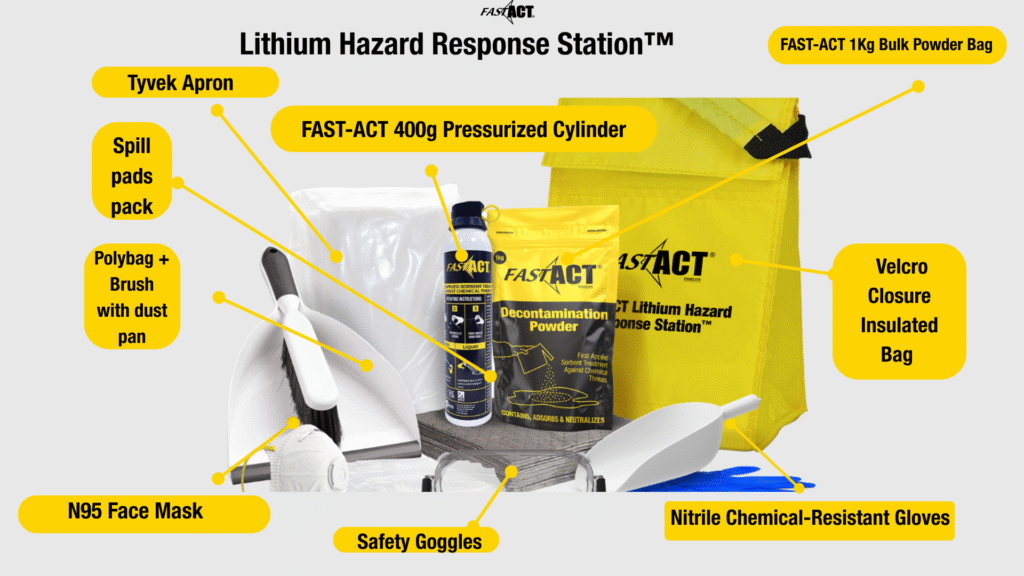
The FAST-ACT Lithium Hazard Response Station™ is built for the chemical side of a battery incident. It is a self-contained kit for responding to chemical hazards from lithium-ion batteries, which can fail because of a drop, puncture, thermal runaway, short circuit, or mechanical damage and release toxic gases, flammable gases, and leaking electrolyte. The kit lets personnel neutralize chemical vapors and liquid spills without the use of water or complex procedures.
The Station includes a 400g pressurized cylinder, a 1 kg bulk bag, spill pads, a brush and dust pan, and personal protective equipment: a Tyvek apron, safety goggles, nitrile chemical-resistant gloves, and an N95 face mask. Because the contents are together in one place, crews know where to find them at the start of an incident.
FAST-ACT is also designed with the responder in mind. It is non-flammable and non-reactive, which matters in an environment where flammable gases and electrolyte may already be present. It is non-toxic, non-corrosive, and safe for incidental skin contact, and third-party toxicity testing shows it is non-toxic to eyes, skin, and lungs. The Station itself is “Proven Safe by Independent Certified Laboratories,” with full test reports available on the product page.
The kit is ready to use, has a five-year shelf life, and can be used across a range of temperatures. It is also usable on sensitive equipment and neutralizes unknown chemicals, so crews do not need to identify the exact chemical first. FAST-ACT is HAZMAT-grade and can work as a standalone product, so crews can begin addressing vapors and spills without waiting for additional resources. It also works alongside existing HAZMAT procedures. The same dry decontamination approach supports other lithium-ion hazards in wildfire and industrial settings, where water may be limited or inappropriate.
How Can Fire and HAZMAT Teams Prepare?
Preparedness for battery incidents comes down to a few practical questions:
- Does your SOP treat extinguishment as the end of the incident? Build in reignition monitoring, atmospheric readings, and decontamination before demobilization.
- Who is responsible for chemical hazards on scene? Assign vapor, spill, and runoff concerns to a named position in the incident action plan.
- Can your crews address contamination in the first minutes? Consider whether that capability is on the apparatus or arrives later with a HAZMAT team. This hazardous materials emergency response article covers how early decontamination fits into the larger response.
- Is your team trained on battery chemistry? Crews make better decisions when they understand what a failing battery releases, not only the procedure for responding to it.
Strengthening Your Department’s Battery Response
New federal standards are a step toward safer products, and they do not change what crews face at the next incident. Lithium-ion batteries are already in homes, vehicles, warehouses, and charging areas, and each failure can release vapors, spills, and contamination that stay on scene after the fire is controlled. A response plan that accounts for the chemical hazards and gives crews a way to address them from the start prepares them for the incident they are most likely to see.
About Timilon Corporation:
Timilon Corporation is the manufacturer of FAST-ACT®, a proprietary formulation of non-toxic high-performance specialty materials effective at neutralizing a wide range of toxic chemicals with the added capability to destroy chemical warfare agents. The FAST-ACT technology is utilized by leading defense agencies, chemical industrial companies, first responders and HAZMAT teams to quickly and safely eliminate chemical hazards. For more information, reach out to Leticia Menzzano, Marketing Manager, [email protected].
FAQs
Why are lithium-ion battery fires a HAZMAT concern?


Lithium-ion batteries in thermal runaway can release toxic gases, flammable gases, and corrosive liquids that persist after the fire is controlled. Responders may also carry contamination on gear, tools, and skin.
Why can water-based methods fall short in a battery incident?
Water can cool a battery fire, but it does not address the chemical hazards already released. Wet decontamination also needs water, personnel, equipment, space, and wastewater management, which may not be available in the first minutes.
What is the FAST-ACT Lithium Hazard Response Station?
It is a self-contained kit for responding to chemical hazards from lithium-ion battery failures. It lets personnel neutralize chemical vapors and liquid spills without water or complex procedures.
Can FAST-ACT be used without a HAZMAT team on scene?
Yes. FAST-ACT can work as a standalone product, so crews can begin addressing vapors and spills without waiting for additional resources. It also works alongside existing HAZMAT procedures.