

Hazardous Materials Emergency Response: What Recent Incidents Teach First Responders
Chemical emergencies do not always begin with a visible spill, fire, or obvious release. Sometimes they begin when water contacts an incompatible chemical. A damaged piece of equipment allows a hazardous substance to escape. Or responders arrive at a scene where the material itself is not immediately known. Several recent incidents illustrate how quickly these situations can develop.
On July 22, 2026, Atlanta Fire Rescue crews responded to a commercial building on Marietta Boulevard NW at 8:15 a.m. after smoke was reported. Investigators determined that water had contacted ammonium phosphate, a hazardous chemical used in plant fertilizers, creating a chemical reaction that produced smoke and an odor. No active fire was found, but the situation required a hazardous materials response to assess and contain the chemical reaction. HAZMAT units neutralized the situation and cleared the area by 10 a.m.
That same day, Arkema Inc. detected a small release of hydrogen sulfide from a unit inside its Houston facility at 9:17 a.m. Emergency response teams worked to stop the leak and clean up the material. An all-clear was issued just before 11 a.m. Officials confirmed the release was contained within the facility and did not spread beyond its boundaries.
Also on the same day, in San Luis Obispo, California, a customer opened a container believed to contain silver, only to discover that it released what appeared to be elemental mercury. The customer and an employee initially attempted to clean up the material before recognizing the potential hazard and contacting emergency responders. The San Luis Obispo Fire Department and regional HAZMAT team responded, assessed the facility, and red-tagged the building. In a follow-up update, the substance’s identity could not be confirmed; readings were low and ultimately inconclusive.
The incidents had different causes and involved different chemicals, but they share an important lesson for first responders: a chemical emergency can change quickly, and the initial hazard may not be the only hazard responders need to manage. Decontamination across high-risk environments introduces operational realities that shift rapidly depending on the chemical involved, the environment, and what information is available at the time of response.
Understanding how chemical reactions, toxic vapors, unknown substances, and contamination can affect an incident is an important part of effective chemical emergency response.
What Can Cause a Chemical Emergency?
Chemical incidents can develop from a variety of conditions, including equipment failures, incompatible materials, improper storage, damaged containers, environmental conditions, or unexpected chemical reactions. For first responders, one of the biggest challenges is that the circumstances surrounding a release may not be immediately clear.
The Atlanta incident demonstrates how a substance that appears relatively contained can become a HAZMAT concern when another material, in this case, water, comes into contact with it. Ammonium phosphate properties can make it a particularly unpredictable hazard in commercial storage environments where the source of water contact may not be immediately apparent.
The Houston incident demonstrates the risks associated with an unexpected toxic gas release. According to OSHA’s hydrogen sulfide guidance, hydrogen sulfide is a colorless, extremely flammable, and highly toxic gas that is heavier than air, meaning it can accumulate in low-lying and enclosed spaces such as manholes, sewers, and underground vaults, making confined space incidents involving H2S particularly hazardous for first responders.
The San Luis Obispo incident reinforces another fundamental principle of HAZMAT response: unidentified hazardous materials require a cautious response. The City of San Luis Obispo Fire Department stated: “When hazardous materials cannot be immediately identified, emergency personnel follow established protocols and assume the safest reasonable course of action until the hazard can be evaluated by specialized personnel. This conservative approach helps protect public health and prevents unnecessary exposure to potentially hazardous materials.”
For organizations that handle or store hazardous materials, chemical emergency response planning should account for more than the initial release. Plans should also consider how responders will identify the hazard, establish control zones, protect personnel, manage contamination, and decontaminate people and equipment. Why effective chemical spill response matters in industrial settings becomes clear when you see how quickly a routine storage or handling situation can escalate into a full HAZMAT response.
What Did the BioLab Chemical Fire Teach Us About Chemical Response?
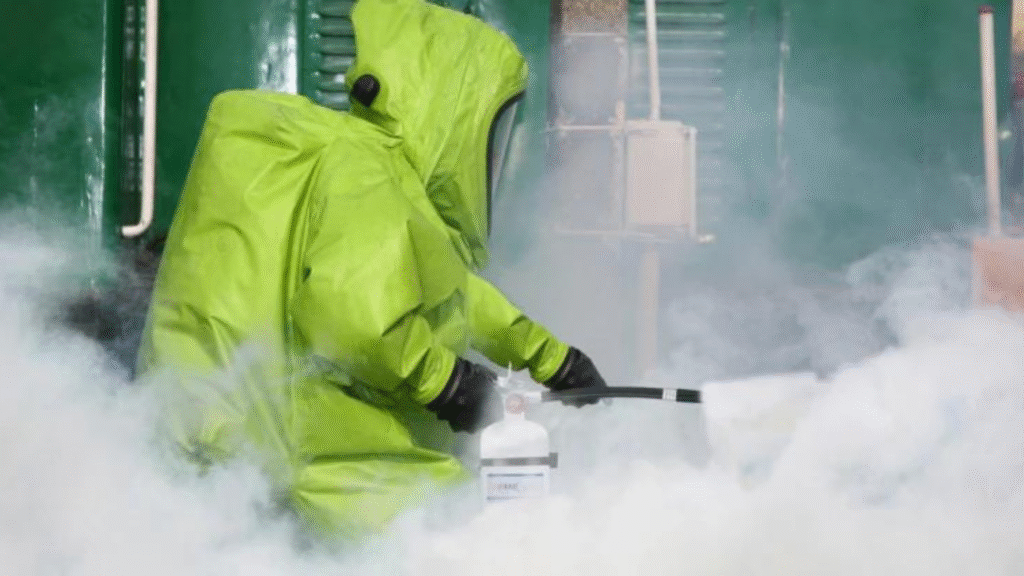
The 2024 BioLab incident in Conyers, Georgia, provides one of the clearest recent examples of how an equipment failure can develop into a large-scale chemical emergency.
On September 29, 2024, water leaked from a corroded sprinkler system and came into contact with highly reactive pool-treatment chemicals stored inside BioLab’s Plant 12 warehouse. According to the U.S. Chemical Safety and Hazard Investigation Board (CSB), the resulting chemical reaction produced off-gassing, significant heat, fires, and a large plume of toxic smoke containing chlorine, hydrogen chloride, bromine, and compounds from more than two dozen chemical families. Approximately 17,000 people were evacuated, while another 90,000 people in the Atlanta metropolitan area were advised to shelter in place. Authorities also issued nightly shelter-in-place warnings to the community within a 2-mile radius for 17 days.
The CSB released its final investigation report on July 21, 2026, the day before the Atlanta, Houston, and San Luis Obispo incidents unfolded.
The CSB’s findings are significant. A December 2023 inspection found more than 1,000 corroded sprinkler heads in the warehouse; the corrosion was caused by chlorine fumes combining with humidity and condensing as hydrochloric acid droplets on metal surfaces since 2019. At the time of the incident, the warehouse stored nearly 14 million pounds reactive chemicals, more than double the approximately 6.2 million pounds Bio-Lab had told local officials to expect when the building was permitted. Stacked rows of chemical bags blocked emergency responders from accessing the initial reaction before flames spread.
CSB Chairperson Steve Owens said: “The conditions and circumstances at the Bio-Lab Conyers warehouse were completely unacceptable. There were nearly 14 million pounds of reactive chemicals stored in the warehouse without proper safeguards in place.” The CSB concluded: “Had Bio-Lab Conyers taken steps to proactively prevent sprinkler system leaks instead of allowing the system to run to failure, the incident likely would not have occurred.”
For first responders, the lesson is not simply that the facility experienced a fire. The more important lesson is what happened after the initial failure.
A problem involving a sprinkler system became a chemical reaction. The chemical reaction generated heat and toxic gases. The resulting plume created a community exposure concern and required evacuation and shelter-in-place measures for weeks. This is exactly why chemical spill response must focus on reducing risk and cleanup complexity from the start. The earlier contamination is addressed, the less complex and costly the downstream response becomes.
The original failure may be outside a responder’s control. Once the chemical hazard exists, however, responders must be prepared to assess the changing conditions, protect themselves and the public, and control the resulting contamination and exposure risks.
How Should First Responders Respond to a Chemical Vapor Emergency?
When a chemical incident produces or may produce hazardous vapors, response priorities can change quickly.
First responders and HAZMAT teams may need to:
- Identify or characterize the chemical hazard when possible (not needed with FAST-ACT Dry Decon)
- Establish appropriate Hot, Warm, and Cold Zones
- Use appropriate personal protective equipment and respiratory protection
- Monitor the atmosphere
- Control access to the affected area
- Determine whether the release can be contained or suppressed
- Protect nearby populations
- Decontaminate exposed personnel and equipment
- Coordinate with EMS, hospitals, environmental agencies, and other response partners
The Houston hydrogen sulfide incident is a useful example of why vapor monitoring and containment are so important. According to OSHA, hydrogen sulfide is heavier than air and can sit in low-lying and enclosed spaces, making atmospheric monitoring and early source control essential components of any H2S response.
Not every vapor emergency occurs at an industrial facility, either. Chemical-suicide incidents can create serious vapor hazards for fire, law enforcement, EMS, and HAZMAT personnel, producing toxic gases in confined spaces and creating both inhalation and secondary contamination concerns that responders may not anticipate at the outset of a scene
This is why responders need to consider not only the immediate source of a chemical release, but also what may be present on personnel, equipment, vehicles, and other surfaces after the initial response. FAST-ACT addresses this challenge through dry decontamination technology providing another option for managing chemical contamination when traditional water-based decontamination may not be practical or immediately available.
Why Is Secondary Contamination a Concern During Chemical Incidents?
Stopping the original release is only one part of a successful HAZMAT response. Contaminated personnel and equipment can potentially carry hazardous substances beyond the initial control area if appropriate decontamination procedures are not followed. This is known as secondary contamination, and research examining HAZMAT events found that at least 17 medical personnel were injured while treating contaminated victims, including 12 EMTs and 5 hospital personnel.
The risk becomes particularly important when responders are working around toxic chemicals, hazardous vapors, or unknown substances. Firefighters, HAZMAT technicians, EMS personnel, law enforcement officers, and healthcare workers may encounter contamination at different points during the incident. Unknown chemical exposure in hospital environments represents one of the highest-risk secondary contamination scenarios, where patients arrive before the substance has been identified and before formal decontamination has been completed.
FAST-ACT Dry Decontamination helps reduce that risk by decontaminating and neutralizing hazardous substances before personnel or equipment move into clean areas.
For first responders, having decontamination capabilities available at the scene can provide an important layer of protection while the incident is being assessed and managed.
Dry decontamination can be particularly useful in situations where water is limited, access is restricted, wastewater management is difficult, or introducing additional water could create complications with certain chemicals. According to NCBI research on decontamination strategies, a serious drawback of water-based decontamination is that while most contaminants are removed and diluted, not all are neutralized or destroyed, and the large volume of fluid used can cause logistical challenges, while contaminated runoff may create additional environmental problems requiring subsequent treatment.
It is not a replacement for every decontamination method or every HAZMAT procedure. Rather, it provides responders with another tool to consider based on the chemical hazard, operational environment, and established response protocols. Understanding weather dry or wet decontamination is right for the situation is one of the most critical early decisions responders face during a chemical incident.

What Should Responders Do When the Chemical Is Unknown?
The San Luis Obispo incident demonstrates another recurring challenge in hazardous materials response: you may not know exactly what you’re dealing with when you arrive. The substance involved was initially believed to be silver. After the container was opened, the material appeared to be mercury, prompting a HAZMAT response and assessment of the facility. Upon further investigation, the substance’s identity could not be confirmed at all as readings were inconclusive.
Situations involving unidentified hazardous materials require responders to avoid assumptions and follow established protocols until the hazard can be evaluated. This is especially important because the physical appearance of a chemical does not necessarily indicate its toxicity, reactivity, or appropriate decontamination method.
For fire departments, HAZMAT teams, industrial facilities, and other organizations that may encounter unknown substances, preparedness should include procedures for:
- Isolating unidentified materials
- Preventing unnecessary exposure
- Identifying the substance when possible
- Establishing appropriate control zones
- Selecting appropriate PPE
- Determining appropriate containment and decontamination procedures
- Rapid response tools available
FEMA’s chemical incident planning guidance notes that the single most effective way to reduce the complexity of response and recovery operations is to limit the extent of contamination from the outset, which requires early intervention before a chemical hazard can spread beyond the original source. A well-developed strategy for unidentified hazardous materials response can help responders make informed decisions when information is limited.
How Does FAST-ACT Dry Decontamination Support Chemical Emergency Response?
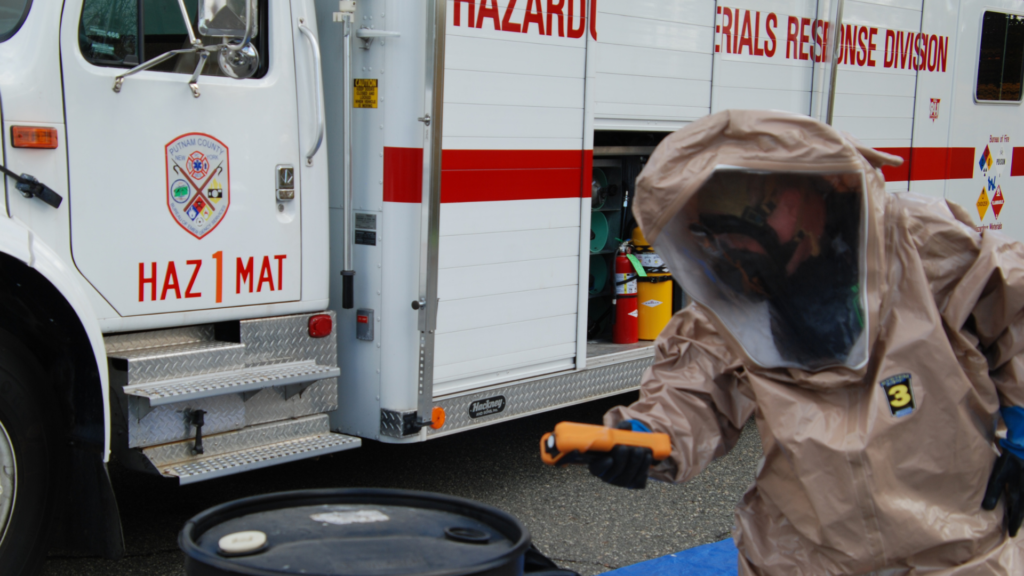
Traditional wet decontamination remains an important component of many HAZMAT operations. However, it can require significant amounts of water, personnel, equipment, space, and wastewater management. Those resources may not always be immediately available during a chemical emergency.
FAST-ACT Dry Decontamination provides another approach for certain chemical hazards and operational situations. Rather than relying on water to remove contamination, FAST-ACT products are designed to help decontaminate and neutralize hazardous substances without generating contaminated liquid runoff. The science behind FAST-ACT’s dry decontamination technology explains why its neutralization-based formulation is particularly effective during the early response window, when the goal is rapid contamination reduction before comprehensive decontamination systems are in place.
For first responders, this can be particularly valuable during the early stages of an incident, when rapid contamination control may be needed before a full decontamination operation is established. FAST-ACT’s dry decontamination technology is designed to support this early-response capability.
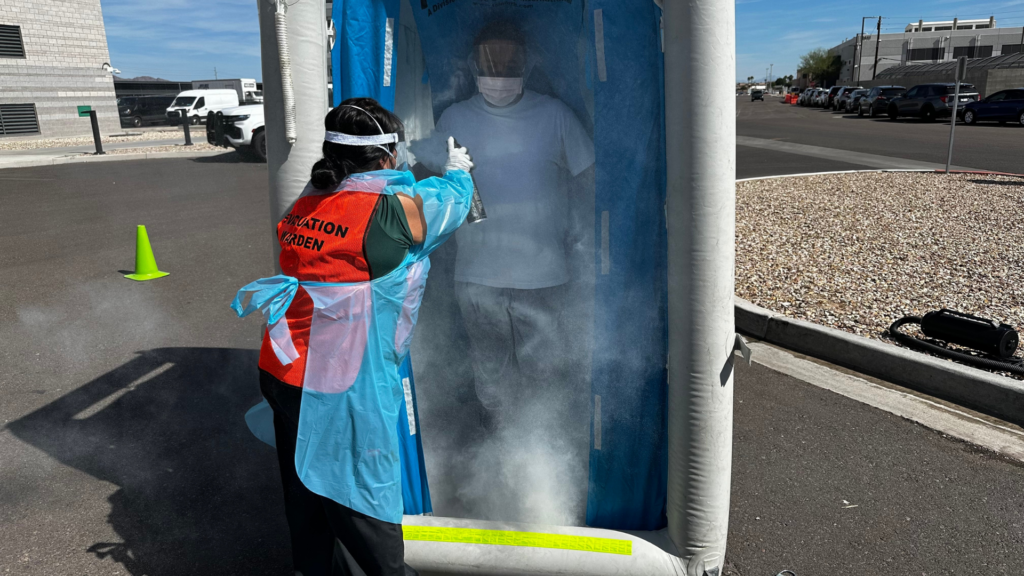
The FAST-ACT 400G Pressurized Cylinder provides a portable option for responding to appropriate chemical vapor threats and supporting rapid chemical neutralization at the source, with an average discharge time of approximately 9.9 seconds, making it well suited for fast-moving HAZMAT environments.
The FAST-ACT Decontamination Mitt is designed for use on skin, surfaces, and sensitive equipment, providing responders with a practical option for removing and neutralizing chemical contamination in the field. *CE classified as a class I medical device for use on skin and surfaces in the EU.
The FAST-ACT Decontamination Wipes can also be used on skin, surfaces, and sensitive equipment, making them a versatile tool across a wide range of HAZMAT scenarios. *CE classified as a class I medical device for use on skin and surfaces in the EU.
The goal is not to replace established HAZMAT procedures. It is to give responders additional tools that can support chemical containment, vapor suppression, contamination control, and decontamination when conditions require rapid action. Not all dry decontamination solutions are created the same. Understanding what to look for in a real solution is an important consideration for any organization evaluating chemical response equipment.
What Can Recent Chemical Incidents Teach First Responders?
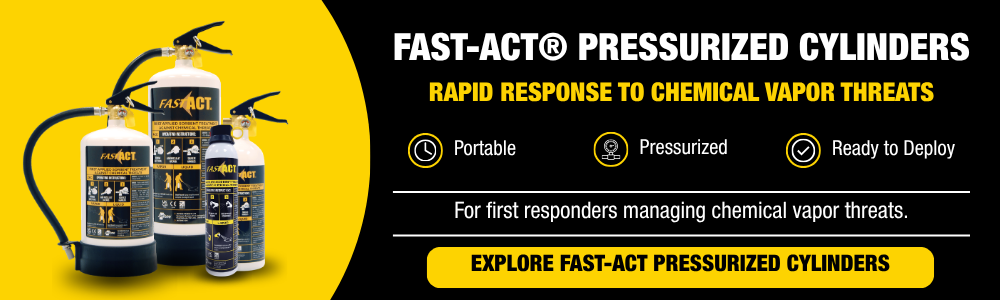
The Atlanta, Houston, San Luis Obispo, and BioLab incidents demonstrate that chemical emergencies can take many forms. But several common lessons emerge.
- Chemical hazards can develop from unexpected conditions.
Water, equipment failures, storage conditions, or damaged containers can contribute to a rapidly changing incident. Chemical hazard response across industrial operations varies significantly by sector, but the underlying principle of early containment applies universally.
- The initial hazard may not be the only hazard.
A chemical reaction can create toxic vapors, heat, fire, or contamination that changes the nature of the response. The BioLab incident demonstrates this more clearly than almost any recent case. A corroded sprinkler became a multi-week community emergency.
- Responders may not immediately know what substance is present.
Unknown chemicals require a conservative approach until the material can be appropriately evaluated. Having a defined strategy for unknown hazardous materials before arriving on scene is one of the most important preparedness steps any HAZMAT team can take.
- Vapor threats require early attention.
Toxic gases can create exposure concerns for responders and nearby communities, particularly in enclosed or poorly ventilated areas. Chloropicrin response illustrates how quickly airborne chemical hazards can spread across a response environment before the substance is identified.
- Decontamination should be considered from the beginning of the response.
Reducing contamination on personnel and equipment can help limit secondary contamination and protect responders, healthcare workers, and the surrounding environment. Annual emergency management training that incorporates decontamination decision-making, not just initial response protocols, ensures teams are ready to act before the next incident occurs.
- Preparedness matters before the incident occurs.
Training, response planning, appropriate PPE, monitoring capabilities, and readily available decontamination equipment can help organizations respond more effectively when a chemical emergency develops.
How Does FAST-ACT Support First Responders During Chemical Incidents?
Chemical emergencies can challenge even experienced response teams. The substance may be unknown, conditions may change quickly, and responders may need to address both the original hazard and the contamination it creates.
FAST-ACT provides dry decontamination and chemical response solutions designed to support fire departments, HAZMAT teams, EMS agencies, law enforcement, industrial facilities, and other first responders. First responder health and safety depends on having the right tools available at the right time, and dry decontamination is increasingly recognized as a critical component of that readiness.
From rapid response to chemical vapor threats with the FAST-ACT 400G Pressurized Cylinder to decontamination of skin, surfaces, and sensitive equipment with the FAST-ACT Decontamination Mitt and Decontamination Wipes, these tools provide additional options for managing chemical contamination during emergency response. The right solution will depend on the chemical, exposure scenario, operational environment, and established response procedures.
About Timilon Corporation:
Timilon Corporation is the manufacturer of FAST-ACT®, a proprietary formulation of non-toxic high-performance specialty materials effective at neutralizing a wide range of toxic chemicals with the added capability to destroy chemical warfare agents. The FAST-ACT technology is utilized by leading defense agencies, chemical industrial companies, first responders and HAZMAT teams to quickly and safely eliminate chemical hazards. For more information, reach out to Leticia Menzzano, Marketing Manager, [email protected].
FAQs
What is chemical emergency response?


Chemical emergency response is the coordinated process of identifying, assessing, containing, and managing a hazardous chemical release while protecting responders, the public, and the environment. Depending on the incident, response may involve fire departments, HAZMAT teams, EMS, law enforcement, environmental agencies, and other specialized resources.
What should first responders do when a chemical release occurs?
First responders should establish scene control, isolate the hazard, identify the substance when possible, use appropriate PPE and monitoring equipment, establish control zones, request specialized HAZMAT resources when needed, and follow established containment and decontamination procedures.
What is secondary contamination?
Secondary contamination occurs when hazardous substances are unintentionally transferred from an original contaminated area or person to other people, equipment, vehicles, facilities, or surfaces. Proper decontamination can help reduce the potential for contamination to spread.
How does FAST-ACT support chemical emergency response?
FAST-ACT provides dry decontamination and chemical response products designed to support first responders, HAZMAT teams, EMS, industrial facilities, and other organizations. Products include the 400G Pressurized Cylinder for appropriate vapor threats, Decontamination Mitts and Wipes for skin, surfaces, and sensitive equipment for portable response preparedness.