

Why European Hospitals Are Shifting Toward Dry Decontamination for Chemical Exposure Incidents
When a contaminated patient arrives at an emergency department, the hospital’s decontamination response has already begun, whether the facility is ready or not. Patients exposed to hazardous chemicals do not always arrive through coordinated EMS handoffs with advance notification. Many self-present directly to the emergency department, often before the exposure has been identified and before any field decontamination has occurred.
This is the operational reality driving a shift in how European hospitals think about chemical decontamination, and why dry decontamination is increasingly being incorporated into hospital emergency preparedness planning as an early-response tool.
Unknown chemical exposure and self-presenting patients represent one of the most challenging scenarios hospital emergency departments face, and one of the most consequential gaps in traditional decontamination planning.

What Is the Critical Gap in Hospital Chemical Decontamination?
The critical gap is the window between the moment a potentially contaminated patient arrives and the moment a functioning full decontamination operation is established.
According to NIH/StatPearls, specialized HAZMAT teams require time to mobilize, and patients exposed to hazardous chemicals are likely to arrive at healthcare facilities before formal decontamination has taken place. Expert guidance indicates that chemical decontamination should begin within one minute of exposure when feasible.
Research published in Disaster Medicine and Public Health Preparedness found that secondary contamination incidents have led to emergency department evacuations, temporary shutdowns, and extensive decontamination operations involving both facilities and healthcare personnel. Secondary contamination is not a theoretical risk, it is a documented mechanism by which a single contaminated patient can significantly disrupt emergency department operations.
Hospital chemical decontamination preparedness gaps, including the absence of immediately accessible early-response tools, remain among the most significant vulnerabilities in emergency department chemical response planning.
Why Are European Hospitals Moving Toward Dry Decontamination?
Traditional wet decontamination- water showers, rinse stations, and decontamination corridors, requires infrastructure, setup time, water supply, drainage, and wastewater containment. Establishing a wet decontamination corridor can take 10–20 minutes from the time a HAZMAT team arrives. Dry decontamination addresses this gap directly, FAST-ACT can be deployed in approximately 1–2 minutes, with no water supply, no wastewater containment, and no fixed infrastructure required.
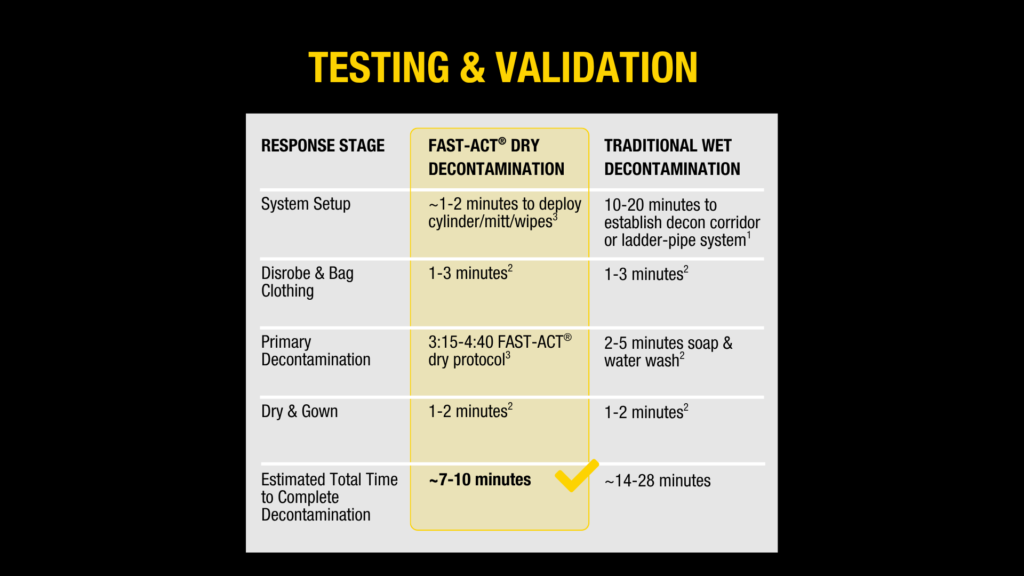
The time difference matters operationally. A complete FAST-ACT dry decontamination protocol can be carried out in approximately 7–10 minutes total. Traditional wet decontamination systems typically require 14–28 minutes to complete, nearly twice as long from setup through completion.
BARDA-funded PRISM research found that removing contaminated clothing alone can reduce external chemical contamination by approximately 80–90%, and that dry decontamination performed immediately after disrobing provides additional contamination reduction before wet decontamination is established. Research published in PLOS ONE found that combining dry and wet approaches provides greater overall reduction than either method alone.
Whether dry or wet decontamination is right for the situation depends on the chemical, patient condition, and available resources. Dry and wet decontamination are not competing approaches, they are sequential ones.
Several factors make this gap particularly relevant in European clinical settings.
European guidance: NATO AMedP-7.1 and EU CBRN Centres of Excellence guides recognize early decontamination as critical for both civilian and military medical services. With protocols varying by country, decontamination solutions must fit existing national frameworks and triage workflows.
Cold weather and patient safety: Research on mass casualty decontamination has found that hypothermia is a documented concern during outdoor water-based decontamination, a particular risk during European autumn and winter months. Dry decontamination eliminates this risk by removing water dependency from the early response.
Pediatric patients: A child’s higher surface-area-to-mass ratio and smaller thermoregulatory reserve make them more vulnerable to both chemical exposure and the hypothermia risks of water-based decontamination. Dry decontamination provides a less distressing alternative that supports both clinical outcomes and patient cooperation.
Infrastructure variability: European hospital emergency departments vary significantly in their access to dedicated outdoor decontamination infrastructure. A systematic review published in Springer/European Journal of Emergency Medicine found that only 49% of surveyed emergency departments had a chemical incident response plan and only 50% reported having a decontamination site.
How Does FAST-ACT Support Hospital Chemical Decontamination in European Settings?
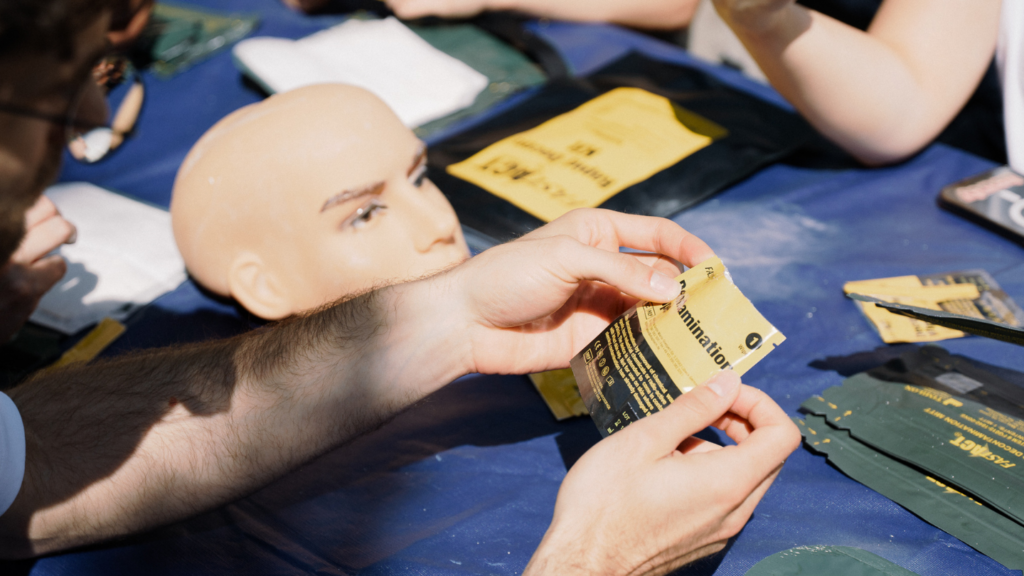
FAST-ACT dry decontamination technology was originally developed for the U.S. Department of Defense and is used by defense partners across Europe. FAST-ACT Mitts and Wipes are CE-marked Class I medical devices for decontamination of skin and surfaces, in conformity with Regulation (EU) 2017/745 on medical devices, placing them within the regulatory framework that hospital procurement and clinical governance teams in Europe work within.
FAST-ACT uses a mineral-based formulation designed to adsorb and neutralize hazardous chemicals on contact. FAST-ACT requires no water and is effective as a standalone dry decontamination method. The science behind FAST-ACT’s dry decontamination technology explains why its neutralization-based formulation is particularly relevant during the early hospital response window.
FAST-ACT deploys through a few operational forms that allow hospital teams to scale response based on patient volume, exposure type, and operational conditions, without requiring fixed infrastructure:
Whole-body application for self-presenting patients:
The FAST-ACT 400G Pressurized Cylinder provides a portable format for rapid whole-body dry decontamination, with an average discharge time of approximately 9.9 seconds.
Localized contamination control:
FAST-ACT Decontamination Wipes provide a portable option for targeted decontamination of skin, PPE, equipment, and sensitive surfaces prior to re-entry, supporting staff safety and facility protection throughout the response.
Skin, PPE, equipment, and surface decontamination:
FAST-ACT Decontamination Mitts provide a targeted dry decontamination option for localized contamination on exposed skin and contact points, designed for use at triage, in ambulance bays, and at patient receiving points.
Not all dry decontamination solutions offer the same level of neutralization effectiveness, an important consideration for hospital procurement teams evaluating options for clinical environments.
What Should European Hospitals Do to Strengthen Dry Decontamination Preparedness?
Strengthening hospital dry decontamination preparedness begins with reviewing existing protocols against the arrival scenario emergency departments actually face, a self-presenting patient, no advance warning, already inside the facility.
That review should address several practical questions: Where are dry decontamination materials staged relative to the triage desk and ambulance bay? Who is trained and authorized to initiate dry decontamination without waiting for the decontamination team? How does the hospital’s protocol account for the critical gap between patient arrival and full decontamination system activation?
Hospital decontamination planning, four key factors every facility should consider provides a structured starting point for hospitals reviewing their chemical incident response protocols. Annual emergency management training incorporating dry decontamination scenarios specific to hospital first receiver operations ensures clinical teams can execute early-phase protocols under real-world conditions.
How hospitals and first responders can begin dry decontamination before full decon is established addresses exactly this challenge, providing practical guidance for managing contamination during the critical early window.
Join the Conversation on December 8
The shift toward dry decontamination in European hospitals is part of a broader evolution in how healthcare systems approach chemical incident preparedness, one that places early-response capability at the center of hospital decontamination planning.
On December 8 at 10:00 AM EST, FAST-ACT is hosting a live webinar “The Shift to Dry Decontamination: Medical Device Solutions for Hospitals and Medical Defense” exploring how dry decontamination is changing hospital chemical response, what the evidence says about effectiveness, and how FAST-ACT’s Class I medical device solutions support hospital preparedness in European healthcare settings.
Register for the December 8 webinar to join the conversation and hear directly from FAST-ACT’s VP of Technology on the shift to dry decontamination in hospitals and medical defense environments.
About Timilon Corporation:
Timilon Corporation is the manufacturer of FAST-ACT®, a proprietary formulation of non-toxic high-performance specialty materials effective at neutralizing a wide range of toxic chemicals with the added capability to destroy chemical warfare agents. The FAST-ACT technology is utilized by leading defense agencies, chemical industrial companies, first responders and HAZMAT teams to quickly and safely eliminate chemical hazards. For more information, reach out to Leticia Menzzano, Marketing Manager, [email protected].
FAQs
Why are European hospitals shifting toward dry decontamination?


Traditional wet decontamination requires water supply, drainage, wastewater containment, and 10–20 minutes to establish a decontamination corridor. Dry decontamination can be deployed in approximately 1–2 minutes with no fixed infrastructure, making it the more practical early-response option during the critical gap before wet systems are operational.
Why is dry decontamination particularly relevant for European hospitals?
Several factors make dry decontamination especially relevant in European settings, including cold weather hypothermia risks associated with outdoor water-based decontamination, pediatric patient considerations, infrastructure variability across European emergency departments, and the need for solutions that fit existing national frameworks and triage workflows.
What is FAST-ACT and how is it classified in Europe?
FAST-ACT is a dry decontamination technology originally developed for the U.S. Department of Defense and used by defense partners across Europe. FAST-ACT Mitts and Wipes are CE-marked Class I medical devices for decontamination of skin and surfaces, in conformity with Regulation (EU) 2017/745 on medical devices, placing them within the regulatory framework that hospital procurement and clinical governance teams in Europe work within.
Does FAST-ACT replace wet decontamination in hospital settings?
No. FAST-ACT is designed to support the earliest phase of hospital chemical response — the critical gap before wet decontamination infrastructure is established. It can be used as a standalone dry decontamination method or as part of a sequential approach alongside wet decontamination. Dry and wet decontamination are not competing approaches